Mirror, Mirror On The Wall…….Who’s Looking the Smuggest Of Them All?
…….I’m referring to the upcoming US Mid-Term elections on 3rd November! With just under four months to go, the race is being shaped by an interesting “push-pull dynamic. On the one hand, polling still favours the Democrats who seem to be on course to win the “House”. Various polls and analyses (e.g. Silver Bulletin, Real Clear) still show the Democrats ahead by about +6% (down from as high as +10% to +15% late-April/early-May). However, on the other hand, the district map has moved decisively into a Republican (GOP) direction because of the aggressive mid-cycle redistricting that has taken place.
Redistricting is the process by which congressional district boundaries are redrawn. Why are they redrawn? It normally happens after the national census conducted every 10 years. What’s unusual THIS cycle is the extent of the mid-decade redistricting – with several states trying to redraw maps before the 2026 election itself! This is something that has been referred to as gerrymandering because it is seen as benefiting one party over another. The effect is to change the electoral starting line even before voters cast their ballots.
The table below shows a reconciliation to help highlight the impact redistricting has (Note: 218 is needed for a majority in the House; GOP = Republican; D = Democrats):
| Step | Approximate seat position | Comment |
| Current House baseline | GOP 220 to Dems 215 | Democrats need a net gain of 3 seats for control |
| Polling-only environment (i.e. without any redistricting) | Dems 225 to 230 | A D+6 national environment would ordinarily imply a clear Democratic pickup |
| Redistricting adjustment | Minus 6 to 10 Dem seats | A GOP-led map changes in states such as Florida, North Carolina, Missouri and possibly Texas |
| Post-redistricting projection | Dems 221 to 224 | Democrats still favoured but only narrowly |
| Majority threshold | 218 | The cushion is therefore small |
This is why a headline polling lead can be so misleading. A Democratic lead of 6% (D+6) sounds comfortable but, after redistricting, it may translate into only a handful of seats above the majority threshold. So, with that said, the sensitivity of the generic ballot lead is crucial here as small movements have a significant impact on the final outcome for the House:
| Generic ballot | Implied House outcome |
| If D+7 or above | Democrats likely win a clearer majority |
| If D+6 | Democrats favoured, but majority probably narrow |
| If D+5 | Effective toss-up / very narrow Democratic edge |
| If D+4 to D+4.5 | Control of the House becomes a real coin toss |
| If D+3 or below | Republicans will likely hold the House |
Redistricting does not guarantee a Republican House because if the national swing to the Democrats is strong enough, it would still overwhelm GOP (see first line in the above table). The point here is that redistricting has lowered the number of seats Democrats are likely to gain from any given national polling lead. The Democrats will likely need D+5 or better to stay in pole position. If their lead falls by just 1.5% to 2% from current levels, their projected majority could easily disappear – and a +/-2% move is perfectly normal “campaign volatility”.
So all this begs the question: how big a task is it for Trump to bring the gap down by a couple of percentage points? It seems totally plausible to me – especially when dealing with a character like Trump! It will likely take a combination of events to pull it off – the biggest being better inflation/cost of living sentiment. Poll after poll shows the latter as top of the list for US households – improve this and you also see a change in the approval ratings. Don’t forget also, it not just about what Trump can pull off – it’s also whether the Dems can hold it together.
Finally, what can we expect of markets & policy from the range of outcomes shown above?
- GOP holds the House: no change to politics and more of the same on the economy (i.e. further tax cuts, continuing deregulation, etc). All this is positive for markets à Risk-on. However, one caveat: expect continuing volatility as Trump has an unfinished agenda that covers Iran, Greenland, Tariffs…..not to mention will resurface and so on. He will have a 2-year runway to do this!
- Democrats take both the House and Senate: Trump ends up a lame-duck President resulting in policy gridlock (politically and economically) à Risk-off environment – with one, key difference: US$ actually sells off on the back of a fiscal crisis.
- A narrow Democrat House win: Dems will do all they can to slow Trump down (e.g. launch investigations) while economic policy becomes blurred à markets lean more to Risk-off (favours bonds as rate moves lean to cuts).
- Comfortable Democrat House win: Dems will exert pressure all round (on Tax, Healthcare, Labour, Climate) while fiscal negotiations become drawn out à mixed results for equities; Treasury moves will be linked to fiscal developments. Trump will try for tax cuts but Dems won’t want to be seen putting the brakes on fiscal spending either!
You might be wondering why there’s no mention of the Senate. This is generally still the Republicans’ stronger chamber. In fact, the Senate and the House are moving antagonistically. Unlike the House, the Senate cannot be redistricted, Furthermore, the Senate seats generally rotate one-third (roughly) every two years. This year, 35 are up for election and the latter look “safer” for the Republicans than the Dems. The Republicans are being attributed a 70% chance of taking the Senate. Even if it’s a dead heat (15% probability), the Vice President casts the final vote. A 15% chance is attributed to the Democrats winning the Senate.
This sets the scene – I will revisit how things look in the days leading up to the elections (3rd November). Let’s see if Trump is still looking “the smuggest” by then.
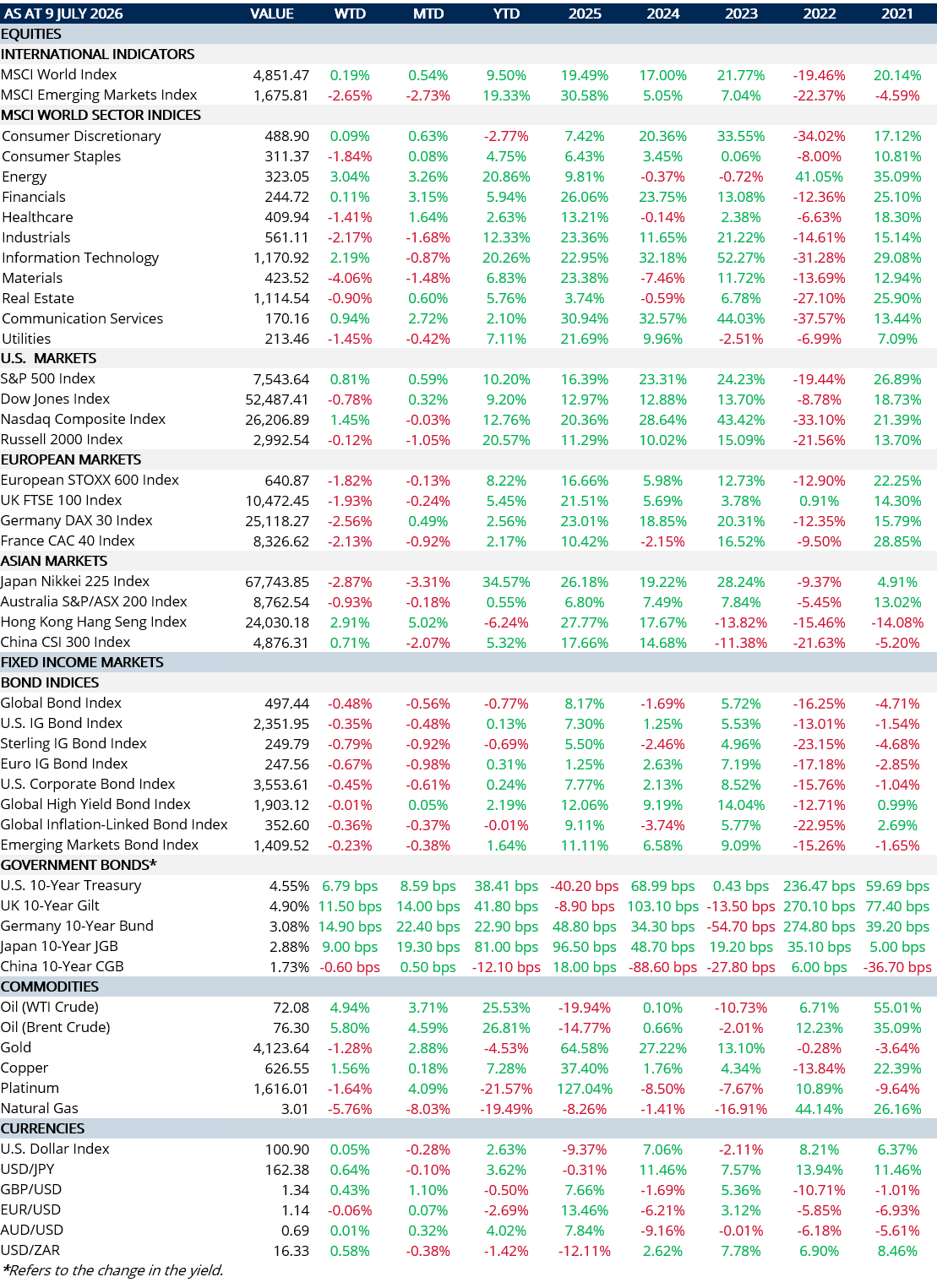
MARKET SUMMARY…
- The rise in government bond yields is largely on the back of renewed tension between the US and Iran.
- The impact of US-Iran has had a manageable impact on oil prices (+5% to +6% on the week). The running theme seems to be: “we’re still talking and we’re still firing at each other”.
- In France, Marine Le Pen has been cleared to run as a Presidential candidate (for RN – Rassemblement National) in next year’s election. She is seen as more divisive than her younger understudy, Jordan Bardella. As a result, French government Bonds (OATs) underperformed.
- In the UK we have had two developments: (1) Nigel Farage is trying to break the current stalemate he finds himself in (over allegations of financial impropriety) by resigning his Clacton seat and seeking re-election. The farce around it all could well see him come up against a comical character called Count Binface who dresses as a trash can and stands as a protest party! (2) Andy Burnham received endorsement from well over 300 Labour party MPs and looks to be well on his way to being chosen as the next leader.
- Impatience grows with Japan’s central bank (the BoJ) – latter seems “content” to walk softly on rates.