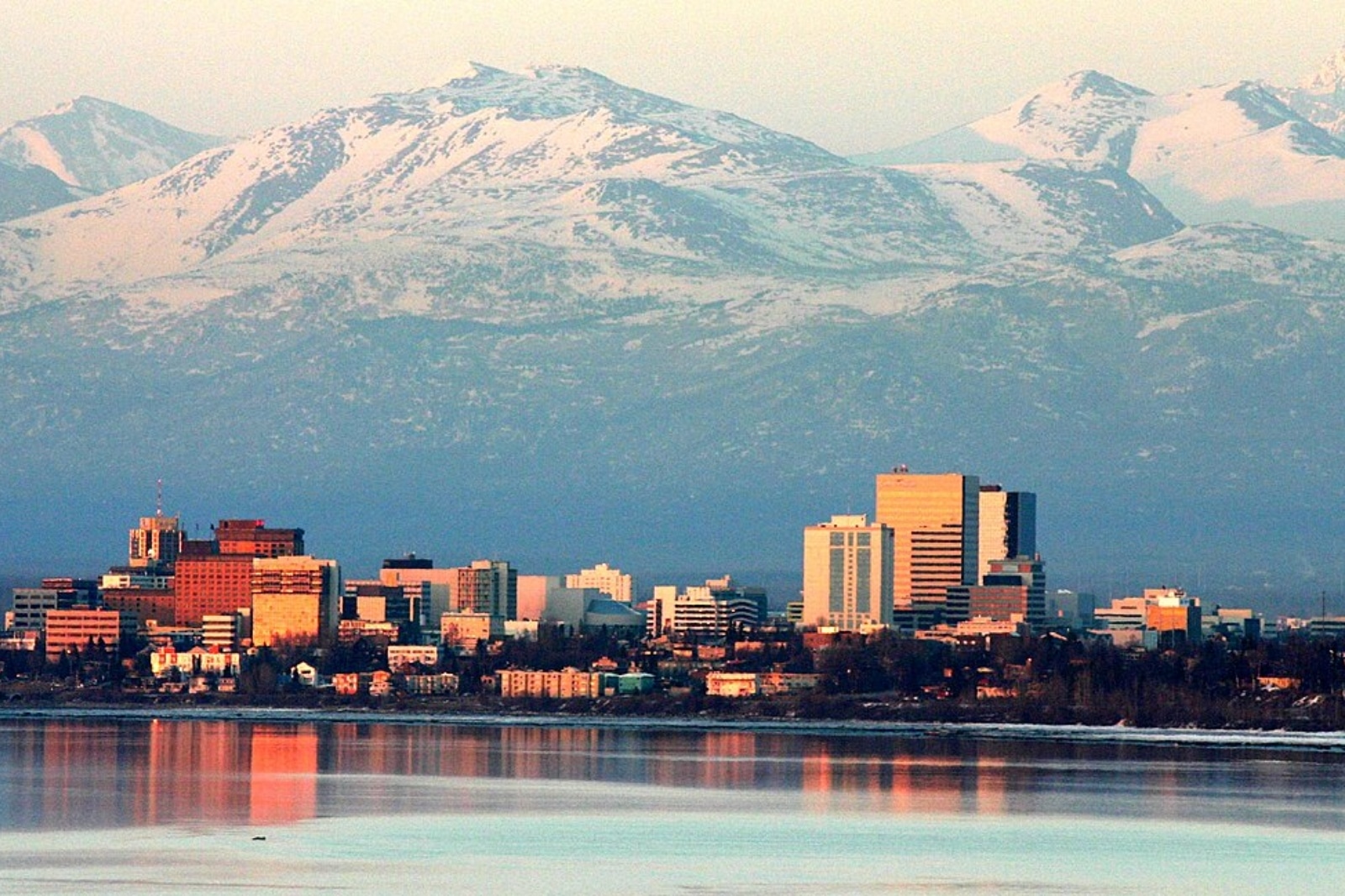
Starting last Friday (15th), President Trump hosted President Putin in Anchorage, Alaska to discuss a path to peace in the current Russia-Ukraine war. It was then immediately followed by a meeting between President Trump, President Zelenskyy and several European Heads of State at the White House. This report begins with the learnings and next steps from these meetings and then assesses what Russia really wants. The final part details sets out what was said and decided at both meetings.
What are the learnings from all this?
- The US is firmly in charge of this peace process. Without Trump, Putin would never have engaged. Trump is working to his own agenda – and the pursuit of peace in Ukraine is merely a cover to fulfil that agenda. The US faces no threat to its borders from Russia – even if it became frosty at worst. The reality is Trump and Putin appear to share a cordial, indeed friendly, relationship – and it goes back a long way in time. Neither suffer fools gladly: Trump is closer to Putin than he is to Europe while Ukraine way down on his list. Trump is essentially pursuing the Henry Kissinger doctrine: a doctrine borne out of a period of US political weakness. It relied on a combination of diplomacy and military power to bring benefits to all relevant players involved and was used to drive a wedge between Russia and China back in the day (first cold war). Trump is doing the exact same thing today. Trump’s agenda (as demonstrated with his strategy over the Panama Canal, Greenland, the Indian Ocean and Taiwan) is about gaining the upper hand over China. To accomplish this, it’s also about control (at least gaining self-sufficiency) around energy, minerals and metals. As highlighted below, Ukraine is estimated to hold some $26tn worth of rare earth metals. A quarter of that sits in eastern Ukraine, currently occupied by Russia. Ukraine is a mere pawn – and a means by which to complete this strategic journey.
- For Russia, this was a massive win and, in the end, it came with zero downside. Putin went to Alaska genuinely concerned Russia would be facing further sanctions. Trump had strongly suggested he would punish Chinese companies that buy Russian oil. Instead, he pushed back on this by 2 to 3 weeks while “talks” play out. As we know from the tariff wars, Trump has a habit of pushing back deadlines again and again! This was a huge let-off for Putin. Putin even managed to get Trump to do a U-turn over his ceasefire demands. This was a bigger coup for Putin than sanctions. It gives him carte blanche to carry on fighting – which is exactly what he is doing by continuing heavy strikes into Ukraine to wear the Ukrainians down while claiming to negotiate peace. They understand each other well. This summit wasn’t just about Ukraine – in fact, Ukraine was quite low down on the list – it was really about business. Both sides brought business delegations to the summit – and Trump loves deals.
- Contrast this with Europe. A beleaguered continent on Russia’s doorstep, its economy weak but, worst of all, incapable of effective decision-making. This is aptly demonstrated by its defence policy. Hiding behind the cover of NATO but actually almost entirely reliant on US support for defence, the presence of Zelenskyy and all those European Heads of State was a farce. It was supposed to be a “show strength…..we stand together” type of thing. In fact, you had Italy’s Meloni caught rolling her eyes at Germany’s Merz (can’t say I blame her!) while Zelenskyy (after his telling off from last time), actually wore a jacket and remembered to thank Trump on several occasions. Europe is on Russia’s doorstep and really needs to watch its back – not just militarily. Look how Russia turned off gas supplies in 2022 following Merkel’s disastrous energy policy. Now it faces losing out as “best friend” status to Russia. Europe needs the US for its own “security blanket”. Europe will remain ineffective until it revamps its own defence spending and comes up with a coordinated & expedient defence strategy that makes it a force to be reckoned with. Until then, it is in no position to go it alone or dictate terms to the US, Russia or anyone else. So why turn up in numbers at the White House? It’s the playground syndrome – stick with the bully or face his wrath! The best it can do is stay close to Trump and hope it can gently “steer” the US position. At the White House, Trump noted European countries “are the first line of defence…..geographically”. He said “We will give them [Europe] very good protection, very good security”…..just wait till they see what it costs them (investments, relaxing trade barriers, etc). The new reality is quite clear: “The US and Russia are now in charge of Europe”.
- Meanwhile, Ukraine is seeing its eastern front slowly succumb to Russian forces in a slow war of attrition. Putin will not stop until he has (see below) either the entire eastern part of Ukraine or major parts of it. His job is not done – and this is why (I believe) he was vehemently opposed to a ceasefire. He needed an excuse to continue the fighting until he has won it. In the meantime, we shouldn’t underestimate the damage Ukraine can inflict on Russian forces. However, this is heavily dependent on continuous supplies of weapons. The best they can hope for is to slow the Russians down.
So, what does Russia REALLY want?? Bluntly….”subordination” of Ukraine’s sovereignty – which, though preferred, doesn’t have to be a full conquest. Here’s why:
- Moscow has long-argued for recognition of its annexations: Donbas (= Luhansk & Donetsk), Zaporizhzhia, Kherson and Crimea. It has full control of Crimea from back in 2014. It now wants to clear the pathway between Crimea and Russia. Blocking their path are Donbas, Zaporizhzhia and Kherson. If/when they get this – and this why “land Transfer” talks will be critical – they will have a major, strategic base from which to strike Ukraine and beyond any time of their choosing.
- From a nationalist perspective, it sees these very much as part of Russia / the old Soviet Union, citing cultural connections and protecting “its” population.
- These annexations, especially Donbas, also have close links to Russia & the old Soviet Union: it has long been a Russian-speaking area due to migration of people. Support for “protection” and “annexations” has increased among Russians post 2022.
- Donbas is an industrial hub with rich deposits of coal, metals (Li, Be, Mn, Ga, Zr, Ti) and rare-earths (La, Cd, Nd, Er, Y). Ukraine’s mineral wealth is estimated to be $26tn with $7.5tn of this in the occupied areas!
- Ideally, Moscow would like full control. However, if this is not achievable, it will want key areas (like Donbas), deny NATO accession for Ukraine, restrict Western arms presence and start the process of easing sanctions (in addition to sanctions relief and asset unfreezing).
- How does it get what it wants? A combination of attritional warfare, divide-delay-rule diplomacy with the US & Europe, nationalist propaganda and continuous terror strikes during the peace process.
On Friday 15th August, Presidents Trump and Putin met in Alaska (Anchorage) to discuss the war in Ukraine. A central point of contention was the process for ending hostilities: whether to implement an immediate ceasefire (as the US, Ukraine and European allies had been calling for) or to negotiate a comprehensive peace settlement first (as Putin has insisted on). Russia’s demands also include the demilitarisation of Ukraine, limits on domestic policies and blocking Ukraine’s path to NATO membership. Here’s what we know was said, what were the outcomes and the decisions going forward:
- They discussed potential land transfers and long-term security guarantees for Ukraine’s future. The latter involved talks of “NATO-like, ironclad” security guarantees. Putin accepted this was essential – but went on to say it must be coupled with the caveat achieving a durable peace requires addressing Russia’s security demands and restoring a fair balance in Europe. Both sides’ guarantees must be in parallel.
- Both acknowledged economic and bilateral issues between their respective countries had “slid to the lowest point since the Cold War” and it was time to “move from confrontation to dialogue”. Interestingly, both brought business reps to the summit.
- When to involve Ukraine and next steps were also discussed. Trump floated the idea of a direct meeting between Putin and Zelenskyy making clear any deal would require Ukraine’s agreement and that it’s up to Zelenskyy to get it (a deal) done. Putin was non-committal and has long-maintained he would only meet Zelenskyy when a concrete peace agreement is ready to sign.
- The tone of their talks was described as “friendly” and “constructive”. Putin even brought up how he felt Trump had been wronged on the US political stage and even questioned the outcome of the 2020 election – agreeing with Trump’s view that mass mail-in ballots were “dishonest” and that the election had been “rigged” against him.
- While no ceasefire deal has been reached yet – or even in sight – Trump instead claimed they had reached an “understanding” and agreed on trying to deliver a comprehensive peace framework rather than a step-by-step truce. Trump even posted on social media “It was determined by all that the best way to end the horrific war…..is to go directly to a Peace Agreement and not a mere Ceasefire Agreement”. Effectively, Trump endorsed Putin’s approach!
- No additional sanctions or penalties were imposed on Russia – Trump even reversed his position over potential new tariffs on Chinese companies buying Russian oil (a type of sanction) for at least “two or three weeks” to give negotiations a chance. It was a significant concession for Russia – Putin had been mindful of additional, new sanctions. This was a real let-off for him.
- In summary, the outcomes boil down to an agreement in principle to keep talking with the aim of reaching a “grand bargain”. In the meantime, the war continues (i.e. no ceasefire, treaty or enforcement mechanisms in place).
On Sunday 17th to Monday 18th August, a White House summit was held between Trump, Zelenskyy and several European leaders of Germany, UK, France, Italy & NATO. The intention was to display a united front of western allies – the reality is no one was fooled by it. The focus was on how to respond to Putin’s proposals. Worth noting Zelenskyy was dressed in more suitable attire and thanked Trump several times! Here’s what we know to have been discussed, the outcomes and the decisions going forward:
- A commitment to provide long-term security guarantees to Ukraine as part of any peace settlement. Trump pledged to protect Ukraine and said “Washington would be involved” in a future security arrangements. Trump also noted European countries “are the first line of defence…..geographically”. “We will give them [Europe] very good protection, very good security”.
- Trump affirmed Putin indicated Russia would accept certain security guarantees for Ukraine as part of a deal. This was touted as significant suggesting Russia might tolerate a Western-backed security pact for Ukraine so long as it’s outside the NATO framework. Trump’s special envoy, Steve Witkoff, told CNN Russia had agreed to “Article 5-like” protections for Ukraine (i.e. US and allies would treat an attack on Ukraine akin to an attack on themselves). Trump did not deny this interpretation…..but neither did he go as far as to express the same.
- Zelenskyy strongly welcomed these security assurances and said his team would work closely with the US over the next 7 to 10 days to formalise this. He went even further: he’s prepared to buy $90bn of US weaponry to ensure Ukraine’s defences!
- What hasn’t been decided are the exact mechanics. Trump said he would not rule out the deployment of US troops….though Russia’s Foreign Ministry has outright rejected any deployment of NATO /European troops joining a security process / peace deal.
- The issue of Trump’s U-turn over a ceasefire is a real concern and has caused uneasiness. Germany and France both made it clear they can’t envisage a trilateral negotiation without a ceasefire in place. Trump instead has said “We can work on a peace deal while fighting continues”.
- There were no signs of Ukraine yielding territory – something Zelenskyy has repeatedly stated he will never do. In Alaska, Putin reiterated his demands for much of the Donbas region to be ceded to Russia in a peace deal. Trump even admitted – to Fox News in an interview – that he and Putin discussed land transfers and even boasted “I think we’re pretty close to a deal in principle……Ukraine has to agree to it. Maybe they’ll say no”. No surprise European allies refused to back this.
- European leaders – aside from pushing back on Trump’s revised stance over a ceasefire and negotiations – also stressed they will continue backing Ukraine militarily and economically. The G7 and EU have been working on a new round of sanctions targeting Russian energy exports while confirming arms deliveries are ongoing, tarin more Ukrainian troops and rebuild infrastructure.
- Among European leaders, there are some nuances worth noting: France’s Macron says Europe must be part of peace talks (not just the US- Russia- Ukraine); Germany’s Merz was blunt that no one can force Ukraine to give up land and would support reconstruction and peacekeeping – but on Ukraine’s terms.
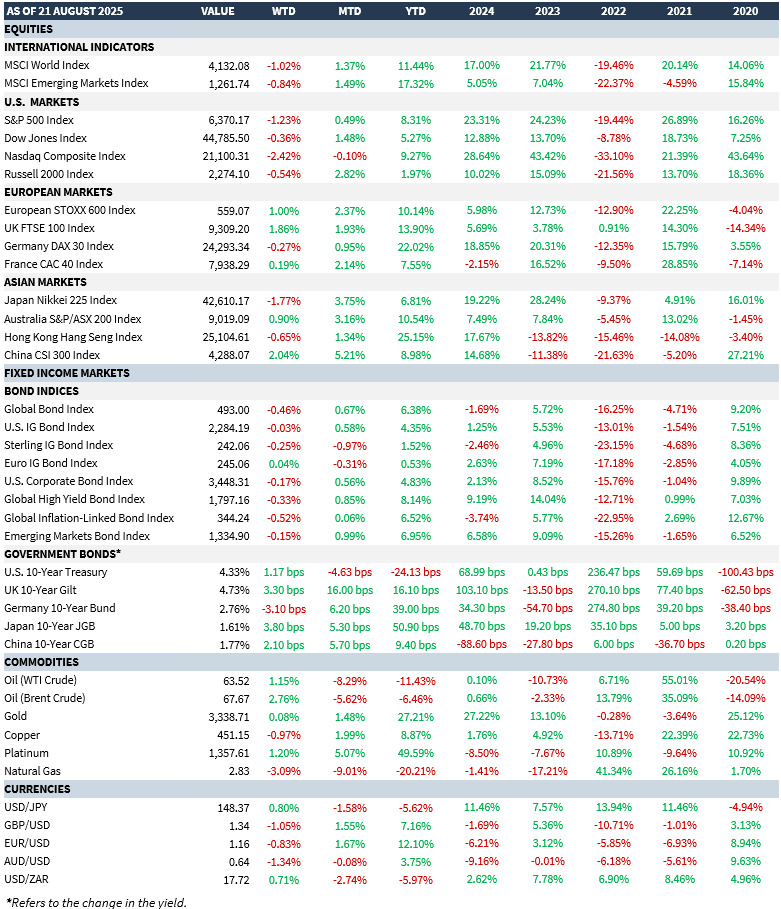
MARKET SUMMARY...