Double, double toil and trouble…..Fire burn and cauldron bubble.
In the above quote, (Macbeth, Act 4; Scene 1), the witches are brewing trouble for Macbeth. In the play, it is the witches that are stirring the cauldron to create chaos, misfortune & ruin for Macbeth; the problem today is that everyone appears to be stirring the same cauldron – and frankly, no one seems to know quite what they are brewing. Substituting for the current world scene:
US/Iran: This is the primary factor dominating world events right now given its impact on energy prices and therefore inflation.
- Iran is moving to a “fully offensive military posture if diplomacy fails. The temporary arrangement that was in place has expired with no new talks planned. Tehran continues to “use” Hormuz and threats against the Guld states as leverage.
- Trump has now threatened to bomb Oman – ironically a US ally and historically an intermediary should Oman “get in the way” of the US’ Iran strategy!
- As a variation on its interpretation, the word “toil” needn’t just represent the witches’ exhausting physical labour. For my purposes, you could interpret it to be the extraordinary amount of effort, military action, threats diplomacy, counter-threats and manoeuvring that has come to characterise the entire conflict.
- On Wednesday, the UAE announced a severing in all economic ties with Tehran after accusing Iran of firing missiles at its territory.
- …..which makes “trouble” the unintended consequences of all that the toil is brewing! Mapping it all out, you have: From US Pressure à Leads to Iranian retaliation à Results in Hormuz pressure àResulting in greater US escalation à Pushing Iran into wider threats against US/Gulf interests à Oman tries to mediate à so US threatens Oman (historically a US ally) à leads to even more regional instability! Now the likelihood of the US attacking Oman is almost zero – but you can see how volatility spikes.
Bond Yields: The market has moved on from Fed Chair’s (Kevin Warsh, KW) communication confusion to something much wider.
- The curve is increasingly telling us this is NOT principally a KW inflation-credibility problem! In fact, there haven’t been any KW speeches, testimonies or FOMC decisions. Key is what’s happened to since US Treasuries on 14th August – despite a run of softer US data releases. KW has not even made any appearances since July.
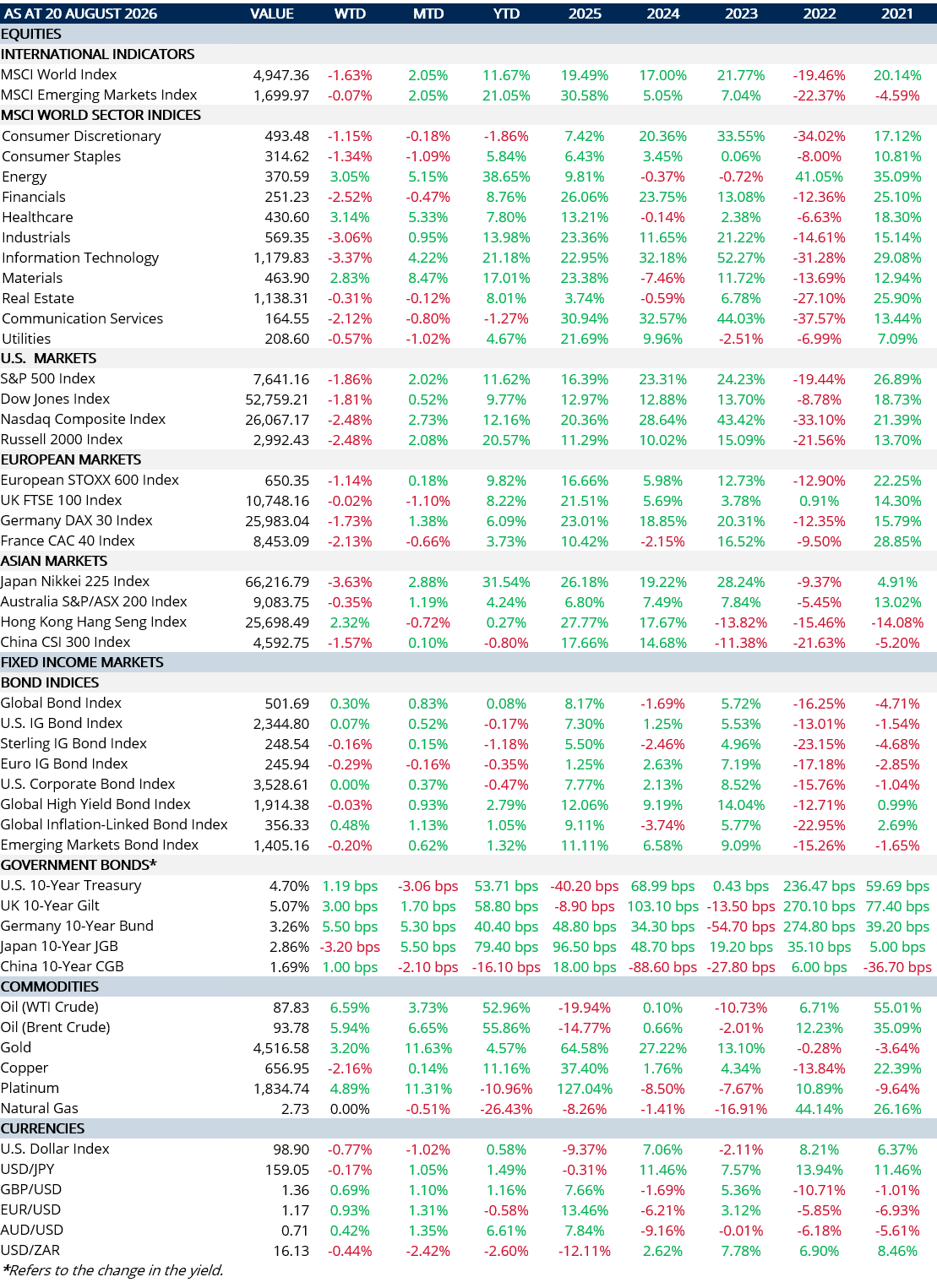
- July’s retail sales fell -0.6% m/m, substantially weaker than expected. I already commented last week on the weak inflation data. All this reduces the pressure to raise rates at the next round…..and yet both the US 10y and 30y Treasuries are rising! At present, they are around 4.65% and 5.20% respectively (almost a 20y high!). Just think how expensive debt-servicing costs are.
- This divergence between soft(er) data releases and rising bond yields is significant. It could be signalling different things: (1) rising risk premia just due to the current global situation or (2) a scarcity of capital sparked by the sheer size of government borrowing vs the surge in AI-related corporate issuance and investment. Probably a combination of both.
- So why blame KW? He’s an easy target – fresh face, fresh approach, change in communication style. Actually, by leaving it to the market, yields are exposing the true term premia seeing as the Fed is not going to get in the market’s way!
- ….and so it was on Wednesday this week, the Treasury department (headed up by none other than Scott Bessent) announced an increased buyback operation for longer-term debt. This is so ironic because on the one hand we have KW saying let the market figure it out while, on the other, Scott Bessent is purposely trying to manipulate long-end yields to bring down funding costs (homeowner mortgages). The buyback programme more than doubles the size of government debt repurchases. Initially, it did the job and drove yields down sharply. This is effectively QE (Quantitative Easing). Under the accelerated buyback programme, the Treasury will target the 10y to 20y and the 20y to 30y portion of the Treasury market by doubling its buybacks from $2bn to at least $4bn. On this announcement alone, the 10y and 30y cratered some 6bps and 9bps (to 4.65% and 5.20%) respectively…..and all this in time for the mid-terms elections! Unfortunately, it seemed short-lived as the market wasn’t buying it for long. On Thursday, they gave back their Wednesday gains as treasuries sold off with investors questioning whether relatively small buybacks can overcome the underlying forces pushing long-end yields higher. This intervention by Treasury (Bessent) does raise an important question: by suppressing the long-end portion of the curve, does that lower KW’s threshold for a policy-rate hike? Recently released minutes suggest the FOMC is already more hawkish than KW himself. It’s now all eyes on the Jackson Hole summit.
Where does it leave KW? So far, his policy judgement is still reasonably well-supported on the back of weak data; his communication regime is still adding some uncertainty premium……but the main driver of the 30y is far broader than general market consensus / headline news: Oil + Fiscal Supply + Global Bond Repricing + Private AI Capital Demand. KW is delivering the TRUE price of capital…….and the market is discovering that long-term capital may be structurally much more expensive than either the Fed and Administration would like (or realises)!
Finally, a quick update on LLMs and Hyperscalers: On Monday 17th, DeepSeek (DS) began raising prices…..and this when DS’ usage lead of token share has widened (OpenRouter: 25.8%). OpenAI stands at 19.2%. Vercel pretty much confirmed the same figures (25.9% vs 19.1% respectively). When it comes to revenue capture, OpenAI receives 10.8% of AI Gateway spend from 19.1% of tokens; DS captures just 3.1% of spend despite 25.9% of tokens. DS’ took effect from Monday…its new peak/offpeak structure raises prices by between 50% and 1100% depending on the model/token type. Of course it’s still quite some way below OpenAI’s but it’s interesting it has started to raise prices. By the way, as much as I would like to take credit for it, I don’t think my article last week was the cause of it. OpenAI is already lowering its costs as evident from its Luna’s API price cut of -80% and Terra’s by over -20%. There are two technological races going on here simultaneously: DS is raising capability while OpenAI is lowering cost. We don’t know what DS’ underlying inference cost or cash burn is…..but we do know it has increased its V4 API prices by 50% to 1100%. DS does need more substantial investment in chips, data centres and specialist staff and explains its move into external fund-raising. DS has also created a premium product tier: V4 PRO scores 53 on AAII (Artificial Analysis Intelligence Index) vs OpenAI’s 59.
Greater intelligence costs money – and eventually, somebody has to pay for it! There is an equilibrium somewhere but nowhere near the extremes as previously thought. Until now, the price/capability favours DS. However, the events of the last few days gives us the first evidence that the price gap itself may already be starting to close…..so don’t waste your time trying to extrapolate today’s inference prices or today’s margins five years ahead!
ECONOMIC & MARKET SUMMARY…
- US Treasury intervention and Bessent vs Warsh status: see above.
- Treasury intervention has weakened the US$ and boosted Gold (and Silver).
- Disruption in the Middle-East has pushed refined-product prices back to Q2 highs.
- Iran peace prospects are taking a different turn, especially with Trump’s threat to “bomb Oman”.
- China’s July industrial production rose at +4.5% y/y (vs June’s 5.3% y/y); retail sales just +0.6% y/y (vs June’s 1.0% y/y); Jan–Jul fixed-asset investment −6.7%. Overall, a weak set of numbers, especially consumer-related.
- Euro Area PMI data reported strength (strongest since November) with Manufacturing at a 54-month high while Services also expanded. Employment strengthened as well.
- UK Services PMI rose strongly to a six-month high while Manufacturing is also in expansion territory.
- Overall, G20 message is one of divergence: China & US momentum is weakening; Europe/UK is proving resilient, even expanding (admittedly off a low base); Japan & Korea face tightening (rates) pressure; Canada is facing mostly energy-driven inflation.