Before I get into the headline caption, first a quick roundup of July as another month flies by. The chart below, courtesy of DB, shows the usual July and YTD returns of selected, global assets (expressed in US$):
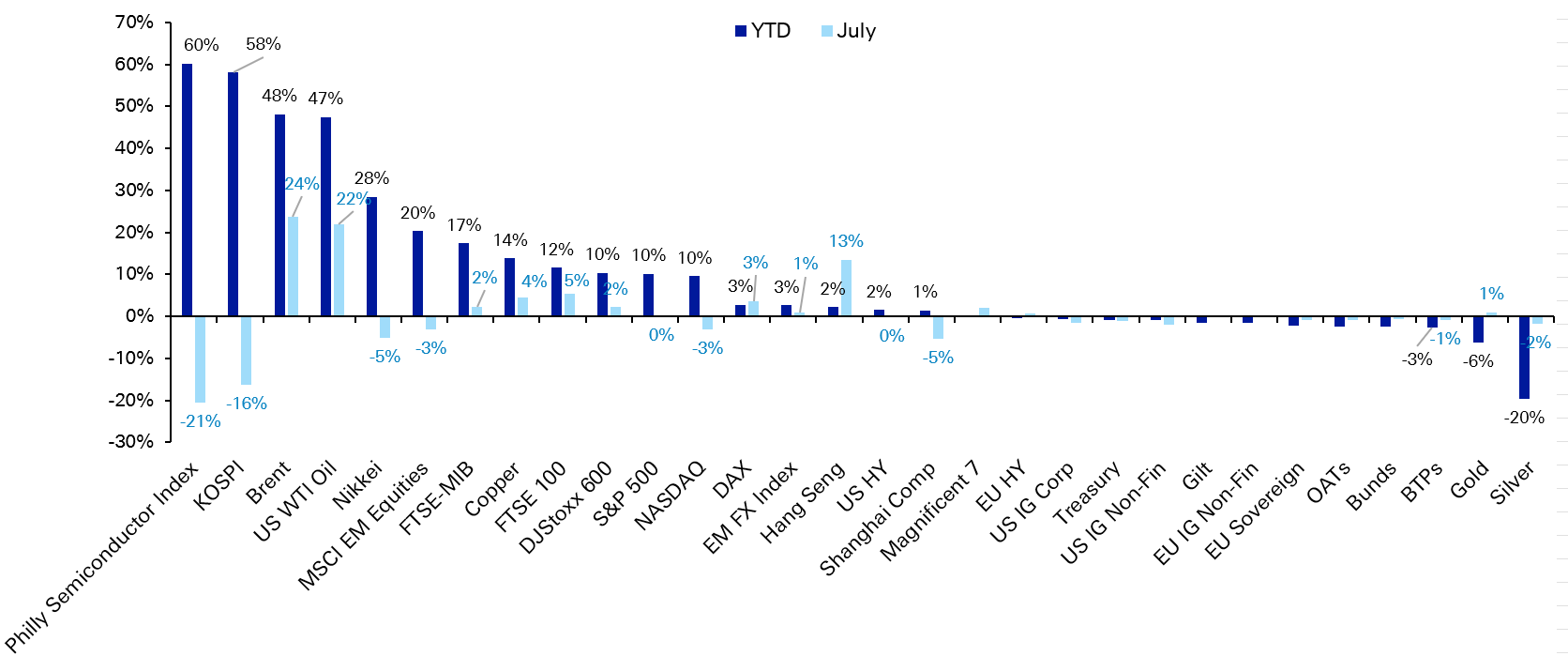
- The Philly SOX got hammered (-21%). Nevertheless, it is still +60% YTD! The KOSPI (Korea’s main index) returned almost the same in both directions (-16% and +58% respectively). As I wrote in last week’s WIR, the AI scene has come under intense volatility as investors reassess the AI trade. The latter is a function of valuations, Chinese competition, CAPEX intensity and supply constraints. Semiconductors bore the brunt – this spilled over into other markets too.
- The S&P 500 was flat on the back of a rotation story; Europe (Stoxx 600) was a similar story on the back of resilience. The Eurozone posted a solid Q2 GDP number.
- The Mag-7 (Magnificent-7) rose just over 2% for the month aided by late-month earnings strength. Microsoft posted its best day since 2008 (it added a record $450bn in market cap in a single session).
- Oil (Brent and WTI) renewed its rise as the conflict escalated between the US and Iran. Both chokepoints (Straits of Hormuz and Bab al-Mandeb) are seeing action.
- In the world of FX, EMFX gained +0.9% while the Yen bounced back sharply towards month-end strongly aided by co-ordinated intervention on the last day.
What about August and beyond? Despite the volatility, the themes remain unchanged: (1) Scarcity around the bottlenecks piling up in the AI infrastructure world as well as on the utility front, especially power generation; (2) Growth in areas such as data centres and all the piping that goes with it; (3) Inflation also caused by bottlenecks that are spilling over from energy into food and further down into electronics components and (4) Private Credit but keep it short duration (2y to 3y with good protections) and select Private Equity (some really interesting VC/early stage plays).
Is the new Fed Chair, Kevin Warsh (KW), redefining central banking? In his two-and-a-bit months in office, bond markets are testing his philosophy vs his predecessors. Following the July FOMC (Fed Open Market Committee) meeting (held roughly every two-months and where rate decisions are made), Treasury yields spiked, especially the long-end as investors seriously wondered if KW is committed to returning inflation rapidly to its 2% target. Remember, for decades (since the 1980s), there has been an obsession around controlling inflation by CBs. For some, this speaks to his credibility while for others, it goes to the heart of how he believes a CB should operate.
- KW’s idea of what a CB should be: he appears less interested in managing markets and more into allowing markets to function. His long-standing view is that the Fed has gradually expanded beyond its original remit (which itself has changed over the decades form “lender of last resort” to “policies that support growth & employment” while also “ensuring price stability”) to guiding markets (“increasing use of rates” to “QE”, “forward guidance”, “macro-prudential regulation”, “stress tests” and “market interventions”). It is NOT Congress that has changed the Fed’s legal mandate – it’s how the Fed has interpreted that mandate! Pre-2008, the Fed focused on 3 things: set rates, manage liquidity in the banking system and act as lender of last resort. Markets were left to determine the rest (long yields, mortgages, bond spreads and equity valuations). Post-2008, they have been meddling in the entire financial system (through QE, FX, stress tests, buying corporate bonds during Covid – even equities in the case of the BoJ! Etc.). All this is what KW seems to be criticising. He’s basically saying: “leave it to the markets”. He’s NOT saying don’t fight inflation or don’t support financial stability.Traditional CB: Raise Rates à Banks charge more à Borrowing slows à Inflation falls [Everything else is down to markets!]Modern CB: Raise Rates à Tell markets what it will do next year à Publish projections à Buy long-end bonds à Influence lending rates à Shape expectations à Markets essentially react to communication from the CB! [Markets follow, they don’t decide!]
- Previous Fed Chairs: the likes of Bernanke, Yellen, Powell – all progressively expanded the Fed’s role via the above measures. KW is the opposite.
- What does it all mean for markets? Well, his philosophy is already being tested! As I mentioned in last week’s weekly, 3 FOMC members dissented and voted for an immediate rate increase in July; policymakers, like Neil Kashkari (on Wednesday), argued the Fed should explain its reaction function more clearly and that the Fed should “start slowly moving up” rates. He was one of the 3 dissenters last week. KW’s response to him was “Do what you think is the right thing to do for the economy”. The other 9 members disagreed. On Thursday, KW dug his heels in further. There were two developments: (1) He reaffirmed his intention to continue with leaner, Fed communication; even though he acknowledged the first communication was imperfect, he still maintains forward guidance only constrains policy & encourages markets to trade the Fed rather than the economy and (2) it has been alleged Trump calls KW often to discuss Iran, AI and economic implications. While this may appear unusual (given previous Fed/Presidential relationships), it does demonstrate Trump respects the Fed’s “advisory” role of policy action on the economy. Nevertheless, all this is resulting in more scrutiny over his relationship with Trump – because people don’t understand this new style and approach. Markets are trying to get to grips with a key question: is KW prudently distinguishing between temporary (supply-driven) & persistent (monetary) inflation – or is he simply letting inflation become embedded through inaction and appeasing Trump!? If KW is right, then stronger productivity (AI-driven), greater market discipline and a less interventionist CB could ultimately deliver lower long-term borrowing costs WITHOUT repeated policy-rate adjustments…..BUT, if he misjudges the persistence of inflation, markets will demand higher inflation premia which means keeping upside pressure on long-yields regardless of whether the Fed keeps rates unchanged!
Summing up:
- KW is not seeking to change the Fed’s legal mandate; he wants the Fed to remain independent but less dominant. He’s redefining HOW that mandate should be executed. For him, it’s less through market guidance and more about letting markets determine financial conditions on their own.Essentially, it’s the very spirit of capitalism!
- It’s starting to become clear why Trump selected him……less meddling in markets and less knee-jerk reactions to short-term events. By remaining focused on the supply-side as well as properly distinguishing between temporary inflation vs structural inflation, this approach has the impact of reducing the number of interest rate adjustments. Right now, given the pressure on raising rates, KW’s approach benefits Trump. However, this is NOT the same as saying he is a puppet of Trump!
- The risk with this approach? If KW is slow to react and/or reacts in the wrong direction, bond yields will let him know with a vengeance.
- KW has always been – and continues to be – pro-productivity and pro-capital investment. He is unusually optimistic about AI, tech innovation, business investment, deepening capital markets, US economic dynamism and supply-side growth. His economic model is: investment à productivity àgreater productive capacity à faster non-inflationary growth à higher real incomes! He is not going to tighten just because GDP is strong, Employment is firm, Investment is booming or Equity markets are rising. Instead, he will ask what does growth actually reflect – excess Agg. Demand or excess Agg. Supply (Productive Capacity)?
- Final thought: who should set rates – the government or the CB? In the UK, it was the government that did so until Labour came into office under Tony Blair (1997). His Chancellor – Gordon Brown – immediately passed that role on to the BoE. The rationale is that rate changes by the government are politically motivated (boost election chances). However, if the CB does it, it removes emotion and politics and stays focused on government-set objectives. Did it work? On paper, yes! Inflation and growth were both remarkably stable, recessions were rare, bond yields fell dramatically, the GB£ was credible. Economists argued CB independence had been proven…..BUT had it?? Look what was going on in the world during that decade: China entered world trade, Eastern Europe opened up, Globalisation accelerated, Labour supply exploded, Technology improved, Cheap imports surged, Productivity rose, Oil was mostly stable à all of which significantly reduced inflation and made the CB’s role a whole lot easier! Interestingly, academic evidence shows countries with independent CBs have generally lower average inflation and less inflation volatility BUT NOT NECESSARILY stronger GDP, lower unemployment, fewer recessions! Since this period, look at the turmoil the world has entered: GFC in 2008, then came COVID and then came Russia-Ukraine in 2022 and now followed by US-Israel-Iran 2026…..and yet CBs remain obsessed with inflation control at the expense of the wider economy!
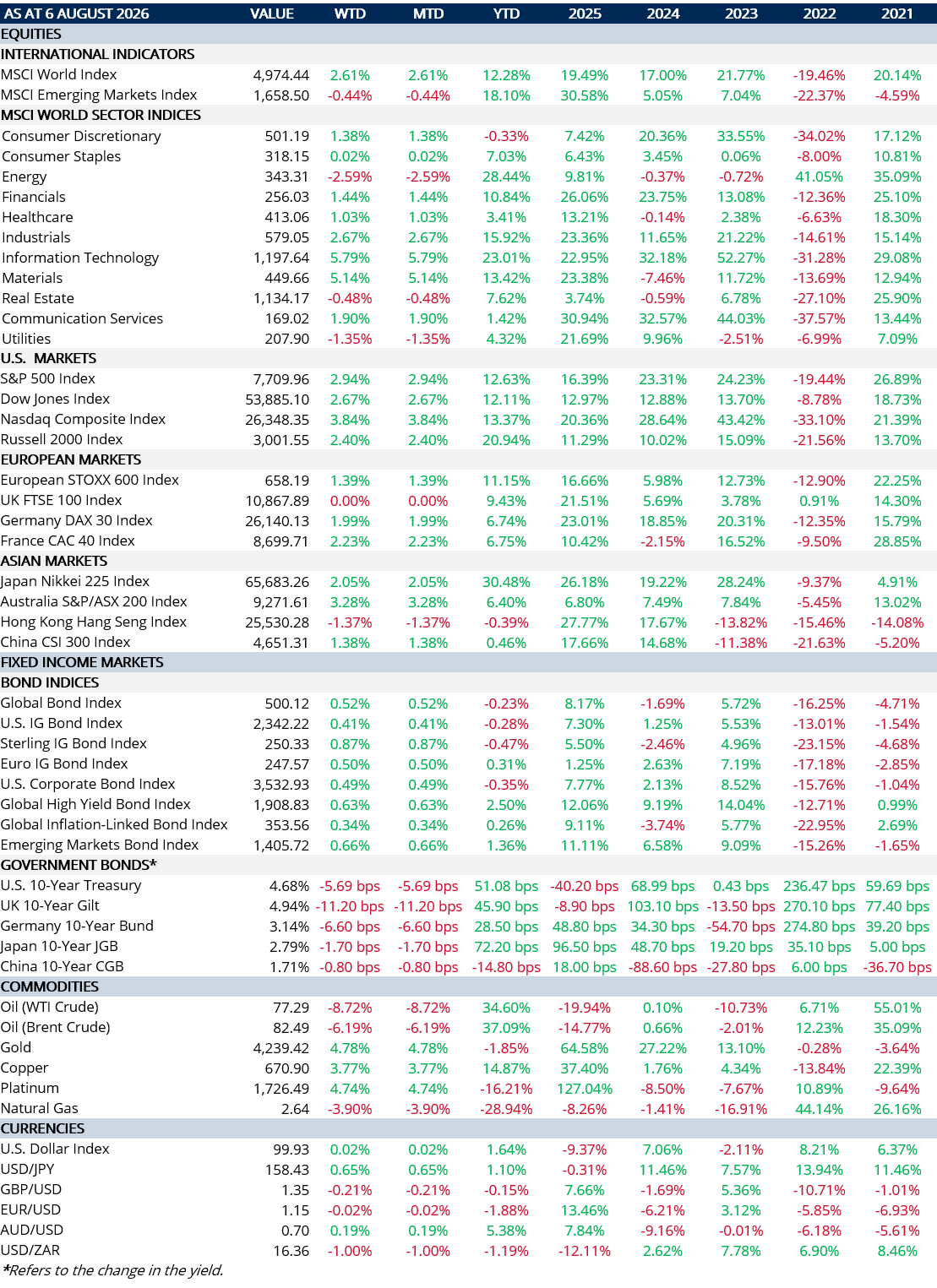
MARKET SUMMARY…
- Over the week, renewed hopes of a peace deal sparked a strong Risk-On rally. The S&P 500 surged to new record highs aided by good earnings. The reality is nothing has been signed. This morning, Iran’s chief negotiator accused trump of “theatre diplomacy” as Hormuz traffic is still near a standstill. Saudi Arabia is bracing itself for “multiple coordinated attacks” by Iraqi militia working with Iran-backed Houthis. Under Iran’s draft plan, US/Israeli ships would be barred from the Strait in an attempt to manage the waterway.
- The US June JOLTS (Job Openings and Labour Turnover Survey) showed a drop in job openings of -178K to 7.359m. It was a little below expectations – mostly due to Healthcare. Factory orders fell -0.3% m/m (vs expectations of a +0.2% rise). It was even worse excluding transportation (always a volatile component) to -0.4% m/m. Growth in factory orders however was revised up.
- Today’s US July employment report showed an unexpected drop in jobs of -23,000; June was revised down by -20,000 while May was revised down by -66,000. Declines in government, education and retail led the fall. Average hourly earnings dropped meaningfully to 3.2% y/y (from 3.5% y/y the previous month). The unemployment rate however slipped to 4.1% as the labour force participation rate fell to 61.4%. We’ve had these situations before and the summer months tend to be volatile. However, overall, this talks to Kevin Warsh’ supply-side theory. Bond yields have fallen quite significantly at the long-end.
- The Yen has been the other big story this week: we witnessed coordinated intervention by US-Japanese officials. The action has seen some short-term respite – with the aim of capping the Yen vs US$ at around 160. It’s all adding up to a futile effort. There is more and more pressure on the BoJ/Government to ramp up rates and close the interest rate differential.