Second wave of inflation fears are returning as renewed conflict in the Middle East pushes oil prices higher, government bond yields rise and investors question whether central banks have truly won the inflation battle.
Volatility is certainly back….and with a vengeance. Have to say I am surprised at the renewed fighting in the Middle east against Iran. I thought we might all get a much-needed rest-bite…..especially ahead of elections. Last week I wrote about “redistricting” and how it has reduced the barrier to winning for the Republicans. I also said GOP (aka Republicans) need to bring the Democrat lead down from about +6% to at least +4%. The latest polling (Real Clear Polling) to 15th July shows the Democrat lead holding at +6%. However, the next two weeks of polling should be more revealing given the resurgence in fighting only really started about three days ago. I can only think the renewed attacks are to deplete Iranian capability in the Strait of Hormuz and “ensure” continued passage for ships. It just sounds extremely naïve to think this objective will be met.
Meanwhile, energy prices have swung like a pendulum. Latest pricing shows oil is back between $80 (WTI) and $85 (Brent) per barrel (pb). Remember, it got to as low as $68 and $71 respectively on the back of a ceasefire. Even the latter was higher than where they were start of the year (about $60 pb or less) and, off the back of that, we saw a fairly quick reduction in inflation. Allowing for the pass-through effect, it will pick up again – hence today’s caption. Financial markets today seem to think the inflation battle has finally been won. Central Banks (CBs) have largely paused rate hikes, equity markets remain close to record highs (despite market movement the last couple of days) and investors have become increasingly comfortable inflation will continue its gradual journey back towards target. All this has complacency written over it. When has inflation ever moved in a straight line? History shows once inflation becomes embedded within an economy, it has an uncomfortable habit of returning just when policymakers and investors begin to relax. It’s not about whether inflation has fallen from its post-pandemic peaks. It clearly has. It’s whether the foundations for a second wave are being laid!
We’ve been stuck in the same old-time loop ever since Trump resumed office two years ago. The same old ingredients keep circling: Energy prices remain volatile, geopolitical tensions continue to threaten global supply chains, government spending is accelerating across much of the developed world and labour markets, while easing, remain historically tight. Meanwhile, bond markets – which often anticipate inflation well before the latter appears in the official data – have become noticeably less convinced the journey back to 2% (still the bizarre target for many CBs) will be smooth.
The conventional, inflation transmission chain is something like this: Energy à Producer Prices à Food & Goods Inflation à Headline CPI à Wages/Services à Core CPI à Bond Yields….and this is fundamental because one of the biggest mistakes economists and politicians make is to assume lower inflation means consumers immediately feel better off. It doesn’t! Inflation measures the rate of change in the price level – not the level of prices themselves. If a loaf of bread rises from £1 to £1.50, that’s inflation of +50% (assuming it was the only item in the inflation basket). If it stays at £1.50, inflation drops to zero because there has been no further price movement. However, try telling the average Jo life is getting better! Once higher food, energy and household costs become embedded, they rarely return to previous levels. Right now, zero cost energy is a pipe dream. Consumers therefore continue to experience a cost-of-living squeeze long after inflation itself has fallen back towards central bank targets. It is hardly surprising so many households remain unconvinced by policymakers who declare the inflation battle has been won.
…….but turning to the main purpose of today’s article, the consequences extend well beyond households. They also impact the government bond market. Look what has happened to bond yields since the start of the war as shown in the chart below. They have spiked across G7 economies. The US 30y has spiked significantly too peaking at 5.18% before dropping back to 5.06%. The latter is a major determinant of mortgage rates.
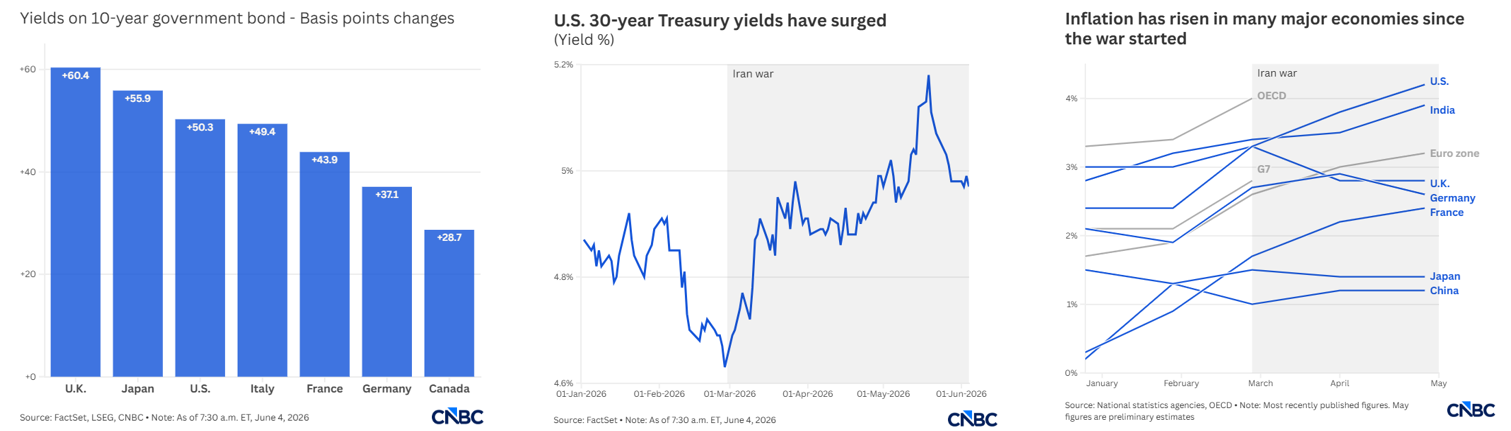
It’s important to note even if CBs do not raise rates, it doesn’t mean life suddenly becomes a return to goldilocks. Long-term yields can STILL rise because investors start demanding greater compensation for inflation uncertainty, heavier bond issuance and worsening fiscal credibility. The last three points are not mutually exclusive – you can have one or more or all three working at the same time. Therefore, we have an alternate transmission mechanism in play:
Higher debt + larger deficits + refinancing at higher yields à rising interest costs à still larger deficits à heavier bond issuance à higher term premium à higher long-term yields.
This is the point made by the IMF’s latest Fiscal Monitor – that public debt remains historically high, borrowing costs stay well above pre-pandemic levels and the age-old combination of low real rates and reasonable growth is fading. So, what is the outlook for 10y Bond Yields in say 12-months from now? In a word: worrisome. I have set below some thoughts around what happens in the table below. The focus is on G10 economies:
| Country | Inflation Outlook | GDP Outlook | Fiscal Position | Refinancing Pressure | Structural Productivity due to AI (i.e. expected improvement in productive capacity without extra inflation) | 12-Month 10y Yield Bias |
|---|---|---|---|---|---|---|
| United States | Moderate | Moderate | Weak | High | High | Moderately Higher |
| United Kingdom | Moderate | Weak | Weak | High | Medium | Higher |
| Eurozone (Germany) | Stable | Weak | Moderate | Moderate | Medium | Slightly Higher |
| Japan | Rising | Moderate | Very Weak | Low | Medium | Higher |
| Canada | Stable | Weak | Moderate | Moderate | Medium | Slightly Higher |
| Australia | Moderate | Moderate | Strong | Low | Medium | Slightly Higher |
| New Zealand | Stable | Weak | Moderate | Moderate | Medium | Stable to Slightly Higher |
| Norway | Stable | Moderate | Strong | Low | Medium | Broadly Stable |
| Sweden | Falling | Moderate | Strong | Low | Medium | Stable |
| Switzerland | Stable | Moderate | Very Strong | Very Low | Medium | Stable |
- The vast majority of countries are witnessing rising 10y bond yields, rising inflation, weak GDP, rising debt/GDP and high to very high fiscal refinancing pressure. This is not a pretty picture.
- Two positive standouts are Switzerland and Sweden. Switzerland has strong fiscal credibility which limits term (i.e. risk) premium pressure while Sweden is seeing good fiscal strength which is offsetting what is still a moderate cyclical recovery.
- Finally, the big elephant in the room: AI. There’s no doubting the productivity impact/effect headed our way. The question is how much? The economic impact will be higher real growth (GDP) and, with it, higher tax revenues. In terms of inflation, it will/should lower unit labour costs. Its likely impact on 10y government bond yields is very difficult to quantify initially – especially in an environment where so many investors are questioning if the AI rally is overdone and due a correction. However, ultimately, it should reduce fiscal risk and, with it, term (risk) premia (e.g. imagine the potential savings in healthcare spending as well as benefits in areas such as education and defence). There is a real chance AI could allow economies to grow out of their debt problems meaningfully.
MARKET SUMMARY…
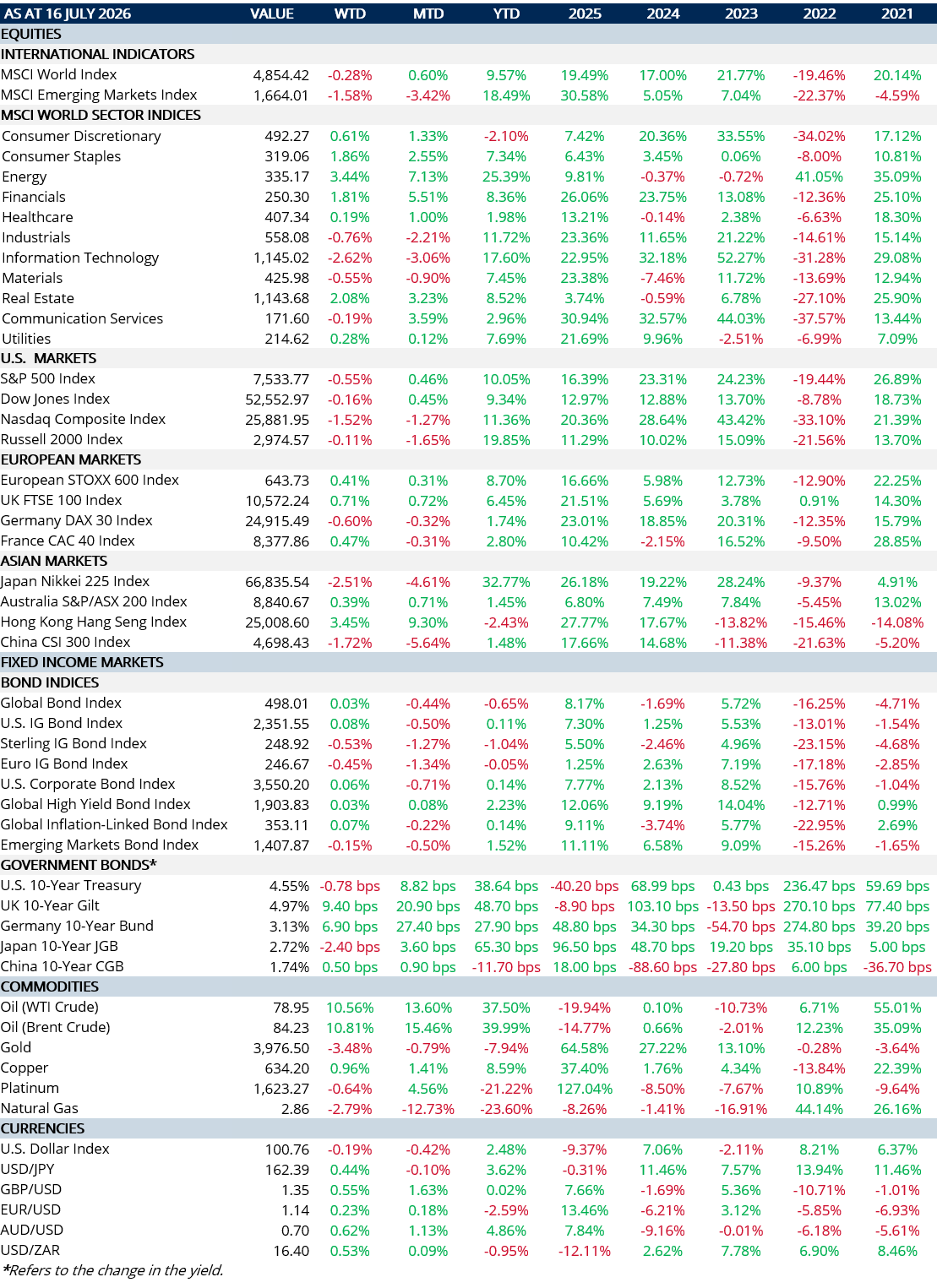
- Not much to say. Energy has risen while equities and government bonds have fallen as markets follow “war-cycle”.
- Gold has fallen as inflationary fears resuscitate.
- One exception have been Japanese government bonds: these moved lower over the past week in response to comments from Finance Minister Katayama who urged domestic pension investors to invest more in domestic securities. If maintained, this could turn into a material development.