What makes for a good leader… rule by Conviction or rule by Consensus?
On Monday, Keir Starmer resigned as UK Prime Minister (PM). His replacement will mark the 7th PM in the last 10 years. His successor is most likely to be Andy Burnham – previously Mayor of Greater Manchester. The latter doesn’t seem to have any opposition in the upcoming leadership contest starting next month. The chart below (source: DB) shows the tenure of each UK PM since 1835:
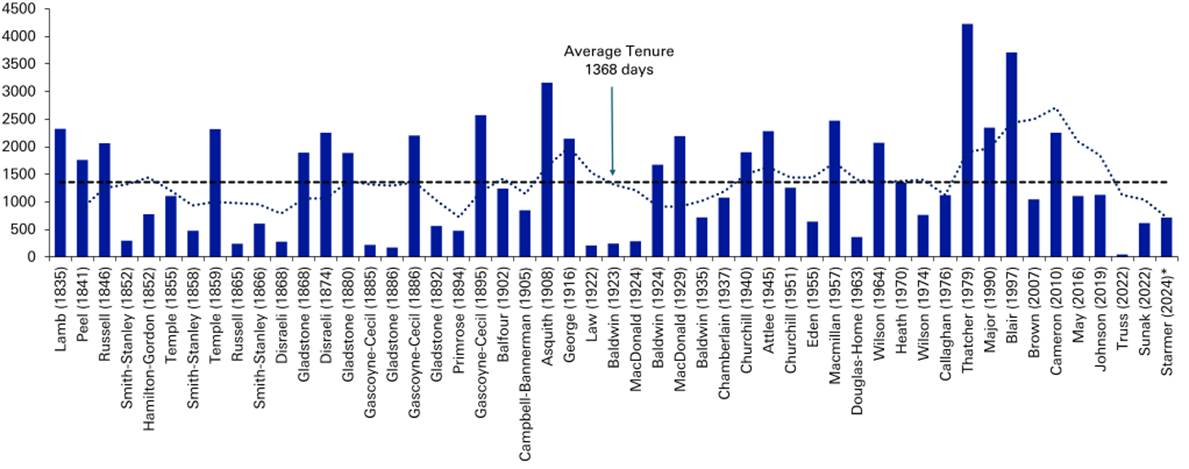
One leader, over everyone else, truly stands out: Lady Margaret Thatcher! While she remains one of the most divisive and controversial PMs in British history, supporters and critics would agree on one thing: she inherited a country in economic and political decline. Instead of trying to manage that decline (as most leaders seem to do nowadays), she attempted to change its direction. To do this, she had a vision, the will to steer a new course and the determination to stick to it. It never bothered her who liked/disliked her. From the same chart, you might be wondering what about Tony Blair? Blair did not rescue Britain! He inherited a country with some structural challenges but he did not inherit a dysfunctional system. In fact, Blair inherited one of the strongest starting positions of any PM in the post-war era (on the back of Thatcher’s legacy).
How did Thatcher go about the transformation of the country?
| Category | Britain in 1979 (year of being elected) | What Thatcher Did | Outcome / Improvement | Market Impact | Leadership Lesson |
|---|---|---|---|---|---|
| Inflation | High and entrenched inflation | Tightened monetary policy and prioritised inflation control | Inflation fell from around 13% to low single digits by mid-1980s (having fallen to 4% by the mid-1980s) | Lower inflation supported bonds, investment and valuation multiples | Address the root cause, not the symptom |
| Trade Unions | Frequent strikes and industrial disruption | Reduced union power through legislation | Working days lost to strikes collapsed from some 29m to under 2m annually | Improved business confidence and productivity | Confront structural obstacles directly |
| State Ownership | Large state involvement; inefficient and often loss-making | Privatised major industries | Telecoms, gas, airlines and utilities transferred to private ownership | Expanded equity market and shareholder participation | Focus on efficiency and accountability |
| Public Finances | Weak fiscal discipline | Controlled government spending and borrowing | Budget position improved materially during the late 1980s | Lower sovereign risk and stronger investor confidence | Financial discipline matters |
| Competitiveness | Declining industrial competitiveness; falling behind international peers | Encouraged competition and deregulation | Productivity and international competitiveness improved | Increased foreign direct investment and corporate profitability | Create incentives for performance |
| Taxation | High marginal tax rates | Reduced tax rates and broadened incentives | Top income tax rate reduced dramatically | Greater entrepreneurial activity and capital formation | Reward enterprise and risk-taking |
| National Confidence | “Sick Man of Europe” reputation | Projected confidence and clear direction | Britain increasingly viewed as a reforming economy | Reduced risk premium attached to UK assets | Leadership is partly psychological |
| Government | Consensus-driven politics | Clear objectives and decisive execution | Greater policy consistency over a decade | Improved visibility for investors and businesses | Clarity often beats consensus |
| International Standing | Perceived decline | Assertive foreign policy and strong alliances | Britain’s influence and credibility strengthened | Improved attractiveness to international capital | Strong institutions require external credibility |
| Long-Term Vision | Short-term crisis management | Pursued a consistent strategy over a decade | Economic transformation was sustained across multiple cycles | FTSE All-Share more than doubled during her tenure | Transformation requires persistence |
What stands out is that almost none of the above actions were designed to (1) win the next news cycle, (2) improve polling next month and (3) satisfy every stakeholder! She was never about being a career politician – she was all about changing the system itself! What she did was bold. Her re-election in 1983 was arguably aided by the Falklands war. Historians/political analysts are divided on this.
Circling back to today’s environment, if Andy Burnham is – as expected – elected as the next PM, how would his style and approach differ to Lady Margaret Thatcher? Also, what will markets make of it all? The projected comparison below is based on his track record as Mayor and what has been reported / said about him:
| Category | Margaret Thatcher | Andy Burnham | Evidence from Burnham’s Mayoral Record (Strengths & Weaknesses) | Likely Investor / Market Reaction |
|---|---|---|---|---|
| Diagnosis of Britain’s Problems | Too much state, too little market | Markets have failed too many people; the state has become too weak and too centralised | Secured greater devolved powers for Greater Manchester and consistently argued Westminster is over-centralised. Strong on governance reform, less evidence that it materially lifted productivity. | Neutral initially. Investors will welcome better governance but ultimately judge productivity and growth outcomes. |
| Role of Government | Smaller government | More active, more devolved government | Introduced the Bee Network, bringing buses under public control and integrating transport. A genuine delivery success, although national implementation would be considerably more expensive. | Mixed. Positive for infrastructure and transport; concern over expansion of the state’s role and funding requirements. |
| Economic Philosophy | Free markets allocate resources most efficiently | Markets work best when partnered by an active state | “Manchesterism” combines private investment with public coordination. Manchester has continued to attract investment, although much regeneration pre-dated Burnham. | Cautiously Positive. Investors generally favour public-private partnerships, provided private capital remains central. |
| Public Services | Competition and private sector involvement | Better funded, integrated and publicly accountable services | Integrated health and social care budgets and improved coordination. Innovative governance model, but healthcare outcomes remain constrained by national funding pressures. | Neutral. Limited direct market impact unless accompanied by materially higher public spending. |
| Ownership | Privatisation | Public control where markets fail | Bus franchising is his flagship achievement. Has advocated greater public involvement in rail, housing, energy and water. These remain largely untested nationally. | Negative for regulated utilities and infrastructure if nationalisation expands. Positive for contractors if investment increases. |
| Growth Model | Enterprise, deregulation and lower taxes | Industrial strategy, infrastructure and regional development | Successfully positioned Greater Manchester as the UK’s leading regional growth engine outside London. Productivity improvement has been more modest than economic growth. | Positive if infrastructure raises productivity. Negative if investment becomes politically rather than economically driven. |
| Labour Market | Labour flexibility | Partnership between business, employees and organised labour | Maintained constructive relationships with trade unions and employers, avoiding major industrial disputes. Critics argue this may reduce labour market flexibility over time. | Mixed. Greater industrial stability welcomed, but persistent wage inflation could pressure margins and inflation expectations. |
| Fiscal Philosophy | Fiscal discipline first | Fiscal responsibility alongside public investment | Managed Greater Manchester prudently, but with limited borrowing powers and significant central government funding. National government would operate under much tighter bond market scrutiny. | Critical. Gilt yields and sterling will become the primary barometer of investor confidence. |
| Decision Making | Strong central executive | Greater devolution to local leaders | Arguably his greatest success. Established Greater Manchester as the benchmark for English devolution, with faster local decision-making and stronger accountability. | Positive. Markets generally favour decisions being made closer to economic activity – provided fiscal discipline remains intact. |
| Political Style | Conviction politician | Consensus builder and coalition maker | Built broad support across business, local authorities and communities. During Covid became an effective advocate for Greater Manchester. Critics argue consensus can slow difficult reforms. | Initially Positive. Markets appreciate political stability but will ultimately judge by delivery over rhetoric. |
| Overall Philosophy | Reduce the role of the state and allow markets to allocate capital | Strengthen the state’s ability to coordinate markets and deliver public services | Burnham’s mayoralty demonstrates he is an institutional reformer rather than a free-market reformer. His national test would be whether that model can be scaled without undermining fiscal credibility. | The decisive question for investors: Can a larger, more active state deliver stronger productivity growth without triggering higher gilt yields, higher taxes and a higher UK risk premium? |
Summing up, What makes a good leader? It’s not about popularity, media appearances or opinion polls. It’s about whether a leader leaves the organisation stronger than when they found it. Thatcher did that by changing the system – regardless of how unpopular it made her. Burnham’s instinct is skewed to consensus. Thatcher famously declared herself a “conviction politician” and viewed consensus as a process of abandoning beliefs and principles. She described it as “something in which no one believes but to which no one objects”. One might argue (Boris Johnson and even Liz Truss aside) all leaders, post-Thatcher, have pursued a consensus approach. For investors, the ultimate judge is the market. If Burnham does become the new PM, gilt yields, the GB£ and business investment will decide quickly whether his model is strengthening the system – or merely managing it!
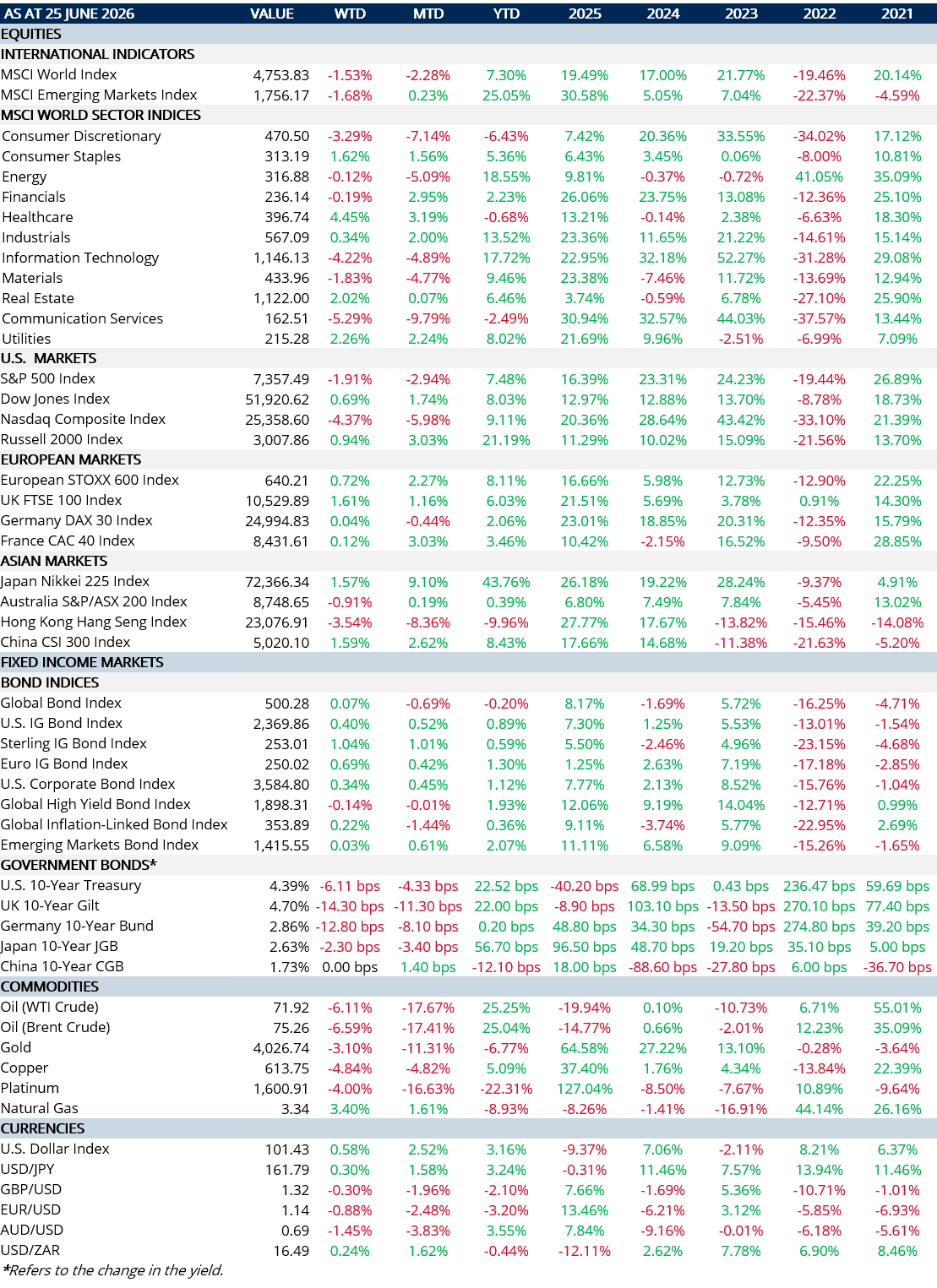
MARKET SUMMARY…
- The war vs Iran has moved from “active military confrontation” to one of “armed ceasefire”. Neither side appears ready to resume full-scale hostilities immediately but it remains tense. Just this morning a vessel came under attack. The US/Iran have agreed an interim framework in which Iran is selling its oil again as some sanctions have been eased temporarily; Israel has accepted a reduction in hostilities but continues to reserve the freedom of action against threats. The next risk is around nuclear inspections, sanctions relief and missile constraints.
- Ships are crossing Hormuz – but not normally. Military escorts remain in place. Latest reports show tanker traffic is rising every day with some 20 mbpd exiting Hormuz (close to the pre-war oil flow). While many vessels avoid Hormuz (lingering mine risks), ships are following routes pre-agreed with / directed by Iranian authorities. All this explains the collapse in oil prices. Brent is roughly back to where it started life pre-war.
- Tech stocks have been hammered this week. What started as a targeted selloff in semiconductor stocks has widened. The Mag-7 is down -13.5%. The other 493 in the S&P 500 is +2.1%.
- Tech stocks are firmly in correction territory (down over -10% from recent highs). Apple fell over -6% on Thursday announcing price increases across parts of its product range. For investors, this raised concerns over input costs (especially memory and storage).
- The tech selloff was particularly severe in Asia. SoftBank fell over -12%. South Korea’s tech-heavy KOSPI fell heavily.
- Gold is headed for its fourth, consecutive weekly loss as Fed rate hike uncertainties prevail.