The attack on Iran commenced Saturday 28th February with airstrikes by US and Israeli (USI) forces. Below is NOT a war analysis – that is best left to the military experts. Instead, it is simply summarising what the objectives might be for both sides, what tell-tale signs to look out for in the weeks ahead (if it lasts that long) and what impact we might expect for the regional/global economy and markets.
What’s the aim? Quite simply:
- USI perspective: Base case: Destabilise Iran by destroying its infrastructure and rendering its defences useless; Best case: instigate regime change as well, ideally with a pro-US-led government! By taking out the Supreme Leader (the Ayatollah), battering Iranian air and naval defences (from the air) and destroying strategic infrastructure, the aim is to leave Iran significantly weakened for years to come, unable to produce & sell oil (a market already controlled by the US) and incapable of pursuing its nuclear interests. The icing on the cake is if it were accompanied by a peoples’ uprising leading to a complete overthrow and change in the current leadership system that is pro-US. There is absolutely no appetite to put boots on the ground!
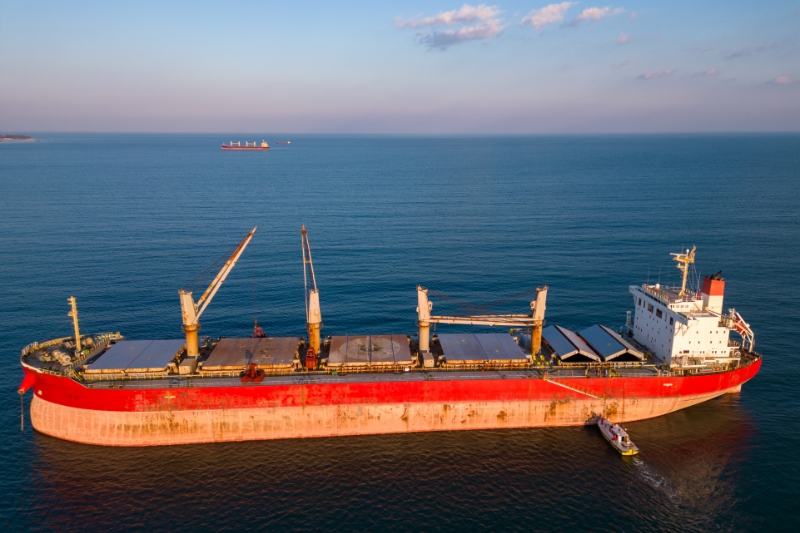
- Iranian perspective: Try and hold it together, drag this war out for as long as they can by responding with targeted strikes causing as much damage and mayhem on surrounding Arab States (oil, gas and military locations) while also inflicting psychological pain on USI (through both missile attacks and via proxies such as the much-weakened Hezbollah in South Lebanon). The big prize would be to seal off the Straits of Hormuz (passage for some 20% to 30% of the world’s oil supply; most affected from this are China, India, South Korea and Japan). Through a combination of higher energy prices and supply chains, inflation would rise giving central banks headaches. If the USI can be drawn into a ground war (“boots on the ground”), this would be a big plus!
What to look out for in the days/weeks ahead to see where things are headed?
Trump latest communication has this operation lasting between 4w to 5w. Unfortunately, from the outset, his Administration’s messaging has fluctuated. Assuming no internal unrest in Iran any time soon – or indeed at all – then what signs will indicate whether this operation is succeeding? For a start, further, sustained, high volume missile/drone/rocket launches. Only this morning I read a report (BlueBay) Iran’s stockpile of the low-cost ($20,000 to $50,000 each), Shahed-136 drones total some 75,000! These are small, fast and easily transported (even via commercial trucks). If so, it would suggest knocking out a vast portion of Iran’s conventional missiles and launchers is far from game-over. Second, strategic surprises (cyberattacks, mission raids, etc). Third, its ability in keeping the Straits closed – despite the destruction of its navy. Finally, is the interim leadership able to keep it together? On its own, aerial bombardment will not bring about regime change. It all comes down to one’s perception of victory!
Market reaction? Textbook! (See market summary section below). It’s a war over transmission mechanisms: Strike → Oil → Inflation → Yields/Markets… and this is where the “four horsemen” analogy comes into play. The first horseman raises the oil price. The second embeds inflation. The third pressures policy. The fourth tightens financial conditions… and it’s when this fourth one begins to ride that markets only truly panic! The key pivot point is oil – does it stabilise below/around $80 pb – bearing in mind it has already shot up from the $mid-60s to the $mid-80s? Today, oil is close to $85 pb at the time of writing! Or, does it start its ascent to $90 pb? Up to $80, risk premium is just about manageable; at $80 to $90, you start to get policy friction; at $90+, you start to see macro regime shifts; at $100+, you start to see serious financial instability risk. Just look at the Russia-Ukraine playbook – we are still suffering form the consequences of inflation to this day. Topping almost every consumer’s priority list is the cost of living. In the table below, I have attempted to summarise the outcomes and implications. The yellow shaded area represents how things have evolved to date.
| Original Horseman (Revelation 6:1–8) | Modern Horseman (2026) | Transmission Mechanism | Oil Price Scenario → Inflation Impact | Asset Allocation Implications |
|---|---|---|---|---|
| White Horse – Conquest | Geopolitical Escalation (Strategic positioning; regional dominance signalling) | Risk premium embedded into crude; insurance & freight rise; volatility increases | Oil up to $80: Contained escalation. CPI +0.3–0.5pp temporary uplift. Central banks look through; Growth changes between 0% (US) to -0.3%. | Neutral equities; overweight Energy (tactical); maintain Duration; modest Gold allocation; modest hedging. |
| Red Horse – War | Direct Military Conflict (Strikes, retaliation, proxy activation) | Hormuz disruption risk → sustained crude repricing → headline CPI lifts → rate cuts delayed, possibly raised | Oil $80–90: CPI +0.5–0.8pp over 6–9 months. Yield curve flattens. | Overweight Energy & Defence; reduce Consumer Discretionary; start trimming duration; start lowering high-beta exposure (HY credit, EM, Cyclicals, Tech); Quality over leverage; Add to Gold. |
| Black Horse – Famine | Cost-Push Inflation Shock (Energy → food → freight → broad input pass-through) | Second-round effects → inflation expectations rise → wage pressure → even tighter, financial (rates & money supply) policy bias | Oil $90–100: CPI +1pp+. Real income squeeze. Growth slows materially. | Start raising more cash; reduce high-beta more aggressively (see above); overweight Commodities & Inflation hedges; shorten duration even more. |
| Pale Horse – Death | Financial Conditions Tightening / Stagflation Risk | Oil spike → higher yields → stronger USD → widening spreads → equity de-rating | Oil $100+: Stagflation scenario. CPI spike + recession probability rises sharply; Growth falls -0.1% to -0.6%. | Outright Defensive: overweight Cash, keep Duration short but start adding Long-end if recession risk builds; cut high-beta; favour Utilities, Healthcare; overweight Gold. |
MARKET SUMMARY...
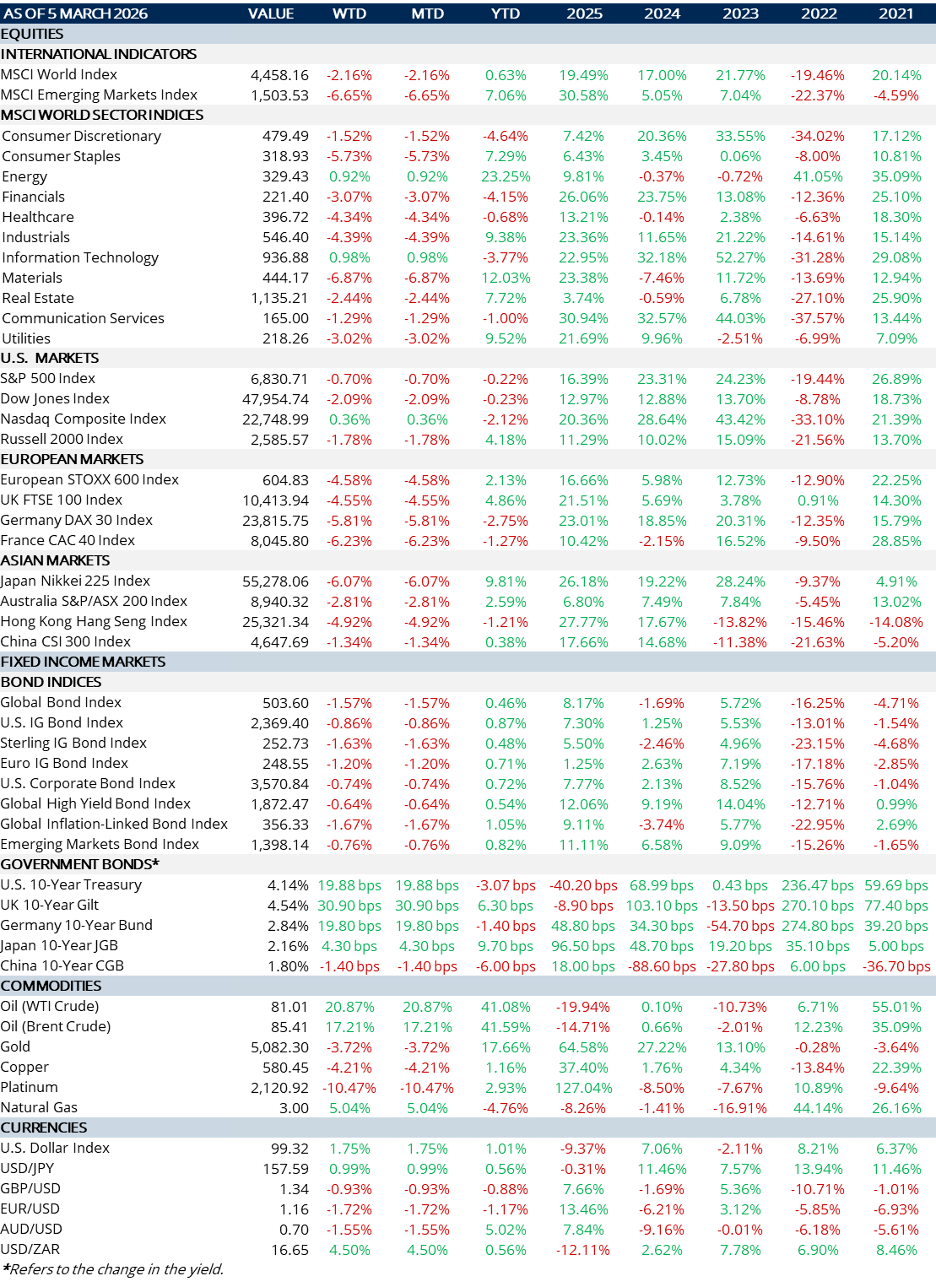
- Energy prices have gone through the roof (Oil: +21%, NG: +5%). This will feed through into inflation.
- 10y Government yields have shot up (i.e. Bond prices have fallen). This implies debt-servicing costs are going to rise and inflation will see upward revisions.
- US$ has risen – a classic Risk-Off move. If you’re wondering why US Bonds and Equities are down when US$ is up, the answer is money is flowing into Money-Market funds (quasi cash).
- Besides energy, the commodity complex has been lower as the US$ has risen. However, further increases in bond yields will start to reignite fears around US$ sustainability. That’s when the likes of gold will “shine” again.