…….when the Genie refuses to go back in the bottle!
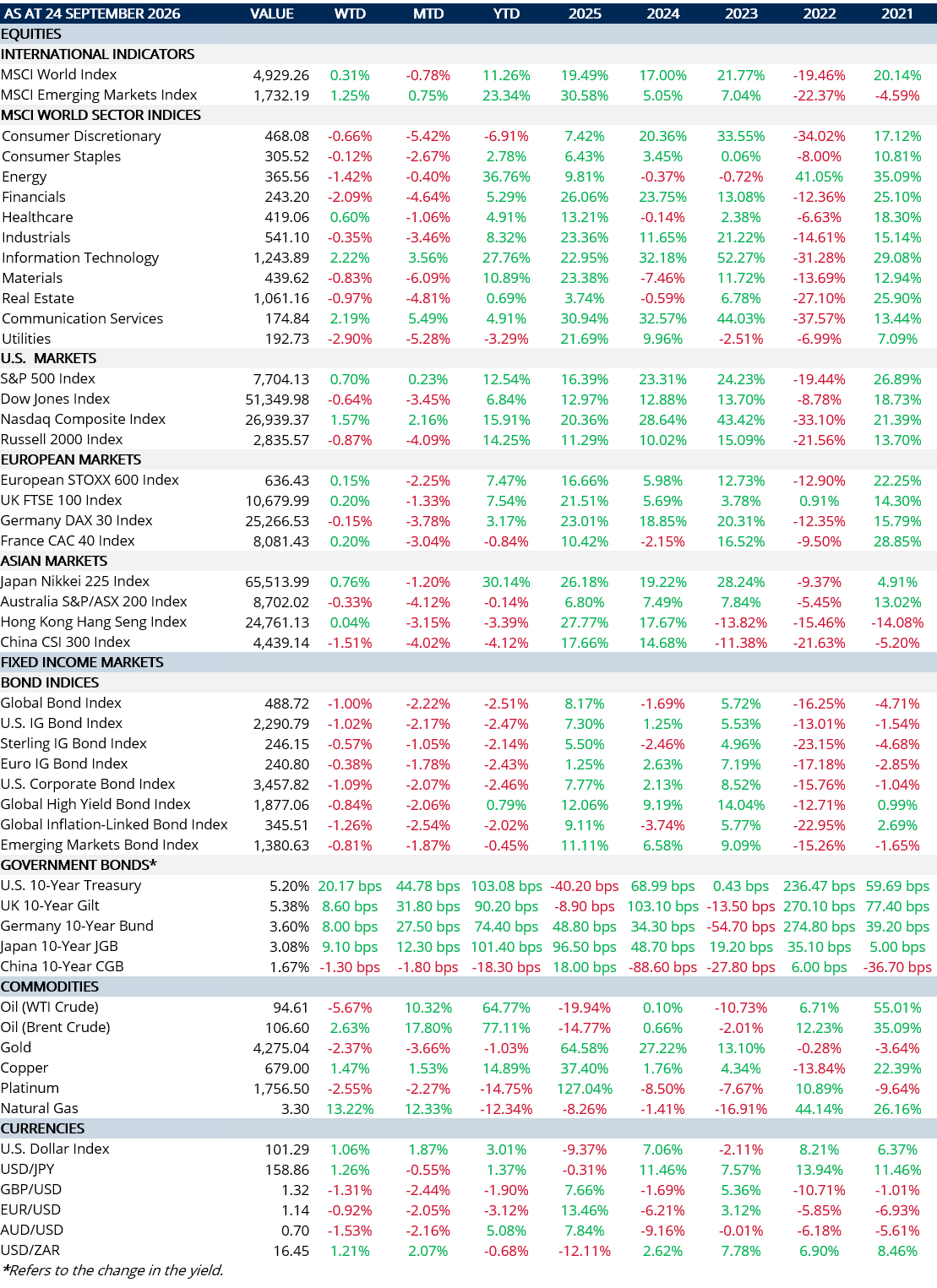
Higher bond yields are becoming impossible to ignore. This morning, “Iran…..offered to reopen the Strait of Hormuz within 7 days and restart nuclear talks”. All this is happening at a time when tensions escalate across the Middle East (Houthis launching missiles and drones at Saudi while Hormuz shipping traffic falls to just 9 vessel transits). Just as well because today’s caption refers to ever-rising bond yields! To say they have moved higher is an understatement. As of midmorning today:
| Country | 10Y yield | 30Y yield | 10Y move, rolling one-month period | 30Y move, rolling one-month period |
|---|---|---|---|---|
| US | 5.19% | 5.47% | +53bp | +30bp |
| UK | 5.38% | 5.87% | +42bp | +16bp |
| Germany | 3.60% | 3.87% | +35bp | +13bp |
| Japan | 3.09% | 4.16% | +21bp | +10bp |
What jumps out is the scale of the sovereign bond sell-off – not just US Treasuries either. Every major market has experienced a material increase in 10y yields over the past month while 30y yields have also risen across all four – just not to the same extent. In other words, there has been a “flattening” taking place at the longer end of the yield curve. As I wrote about before, the significance of this is higher interest-servicing costs on debt – not existing but new debt that finances new funding. It would be wrong to assume ALL debt suddenly moves higher.
This leads nicely into a major issue: The Global Maturity Wall. By kicking the can down the road all these years, that same can has simply become bigger! The issue isn’t just about the sheer size of debt outstanding – but HOW MUCH of that debt now needs to be refinanced at substantially higher rates given where yields and interest rates are moving. The OECD’s Global Debt Report 2026 (published March 2026) addresses much of this issue:
| Funding / Refinancing Pressure | Latest | Why it matters |
|---|---|---|
| Government + Corporate borrowing in 2026 | $29tn | +$4tn / +17% vs 2024; roughly double a decade ago |
| OECD Sovereign borrowing in 2026 | $18tn | Record borrowing requirement |
| Of which: refinancing existing Sovereign debt | 78% | $14tn is refinancing rather than new borrowing |
| OECD fixed-rate Sovereign debt maturing 2026 to 2028 | ⅓ of outstanding | Huge volume of legacy debt rolling over |
| IG Corporate debt refinancing 2026 to 2028 | 24% of outstanding | 65% of maturities currently carry coupons ≤4% (a significant refinancing gap!) |
| Non-IG Corporate refinancing 2026 to 2028 | 31% of outstanding | 67% currently carry coupons ≤6% (significant refinancing pressure building!) |
| 9 major AI companies: projected Bond issuance 2026 to 2030 | $1.2tn | New borrowing competing for the same capital |
The issue is: cheap legacy debt maturing à refinances at today’s much higher yields à interest expense rises à earnings impact à more capital required à investors demand greater compensation. To make things even more complicated, governments and corporates have responded to higher long-term borrowing costs by shortening the maturity of new issuance. The share of more than 10y issuance has fallen to its lowest level since 2009 for sovereigns and the lowest on record for corporates.
This leads into the next major issue: Valuation based on the Dividend Discount Model (DDM). At its simplest, the value of an equity is the present value of its future cashflows. So, comparing – and contrasting – current (trailing) dividend yields of four, major indices to their national sovereign 10y yields, we have the following:
| Market | Current dividend yield | Current 10y sovereign yield | Yield gap (i.e. Equity dividend yield minus 10y Sovereign yield |
|---|---|---|---|
| S&P 500 | 1.04% | ~5.2% | ~-4.2% |
| FTSE 100 | 3.08% | ~5.4% | ~-2.3% |
| Euro Stoxx 50 | 2.32% | ~3.6% | ~-1.3% |
| TOPIX | 1.8% | ~3.1% | ~-1.2% to –1.4% |
In other words, the risk-free alternative is becoming increasingly competitive with equity income. For instance, in the US, an investor can earn roughly 5% or more from a 10y Treasury vs say a 1% cash dividend from the S&P 500. That’s NOT to say Treasuries are automatically preferable! However, it does mean considerably MORE of the equity valuation must now be justified by future growth.
| Index | Div. Yield | 5Y Div. Growth* | Terminal Growth* | +25bp | +50bp | +100bp |
|---|---|---|---|---|---|---|
| S&P 500 | 1.04% | 11.0% | 4.0% | -14.5% | -25.4% | -40.5% |
| FTSE 100 | 3.08% | 5.0% | 4.0% | -7.0% | -13.0% | -23.0% |
| Euro Stoxx 50 | 2.32% | 7.0% | 3.5% | -7.3% | -13.7% | -24.1% |
| TOPIX | 1.8% | 8.0% | 2.5% | -9.6% | -17.6% | -30.0% |
*The valuation changes are NOT market forecasts! These are based on a two-stage DDM. Only the Sovereign/Risk-Free rate is being “shocked” in the above (i.e. +25bp, +50bp and +100bp). The rest (dividend growth, terminal growth and equity risk premium) are all held unchanged.
The message is stark: the lower the current dividend yield/or more distant the cashflows, the greater is the theoretical sensitivity to higher discount rates. That’s why the potential impact is so large – particularly in the case of the S&P 500! What happens if the discount rate (sovereign) permanently rises say +50bp and absolutely nothing else changes? Real markets do not behave like that because a +50bp hike may well coincide with a stronger nominal GDP à stronger revenues à stronger earnings à stronger dividends.
If +50bp theoretically knocks -25% off the S&P 500 DDM valuation, how much additional earnings/dividend growth is required to restore that 25% back i.e. can we grow our way-out f it?? This is where the distinction between Corporates and Sovereigns becomes key:
- CORPORATES: the key question is what level of earnings offsets the refinancing pressure? OECD identified 24% of global IG (investment grade) corporate debt and 31% of non-IG debt outstanding as of end-2025 that needs to be refinanced in 2026 to 2028. Of the debt coming due, 65% of IG carries a coupon of 4% or less and 67% of non-IG carrying a coupon of 6% or less! The OECD expects much of this legacy debt to refinance at a higher cost. The issue is whether earnings can rise quickly enough to absorb them e.g. a company refinancing 25% of its debt from 4% to 5% increases the total interest bill by some +6% EBITDA (Earnings Before Interest, Tax, Depreciation & Amortisation) growth to preserve Interest Cover (IC). Refinancing the same portion at 6% raises that hurdle to around 13% of EBITDA growth.
- SOVEREIGNS: the key question here is how much growth offsets higher rates? It’s wrong to suggest GDP has to exceed the 10y Bond yield because governments refinance gradually, not the entire debt at the same time. The relevant rate is the effective interest rate across the ENTIRE debt stack – not today’s marginal 10y yield. The OECD’s research show interest payments amounting to some 3.3% of GDP in 2025. It projects this to add +2.5% to the OECD debt-to-GDP ratio while inflation reduces it by 2.4% in 2026. In other words, the beneficial denominator effect from inflation is no longer keeping ahead of the interest bill.
CONCLUSION: Can we grow our way out of this?
Possibly – but the hurdle is rising!
- For corporates, the issue is can earnings grow faster than the interest bill? If 25% of debt currently costing some 4% refinances at 5%, the total interest bill rises by some 6%; refinance it at 6% and the increase becomes some 13%! It requires a roughly corresponding amount in growth to preserve existing interest cover.
- For governments, the issue is nominal growth vs the effective interest rate on the entire debt stack – NOT today’s 10y yield. As more cheaper legacy debt refinances at today’s higher rates, that effective rate rises to and so does the growth hurdle.
And the great paradox? AI! AI is currently PART of the problem: Capex à Borrowing à Capital Demand à Yields rise. If ultimately it delivers the promised productivity gains, AI could become part of the solution: Productivity rise à Earnings/GDP rises à Greater capacity to absorb those higher financing costs. It all comes down to timing. A US/Iran settlement would certainly help put PART OF THE GENIE BACK INTO ITS BOTTLE. However, it doesn’t change the Maturity Wall, Government deficits or the extraordinary competition for capital!
The final answer may not even be substantially lower yields at all; it may be sufficiently stronger earnings, productivity and nominal GDP growth to LIVE WITH HIGHER YIELDS! The Genie may eventually go back in the bottle – but only partly. It’s highly questionable whether it still fits!
ECONOMIC & MARKET SUMMARY…