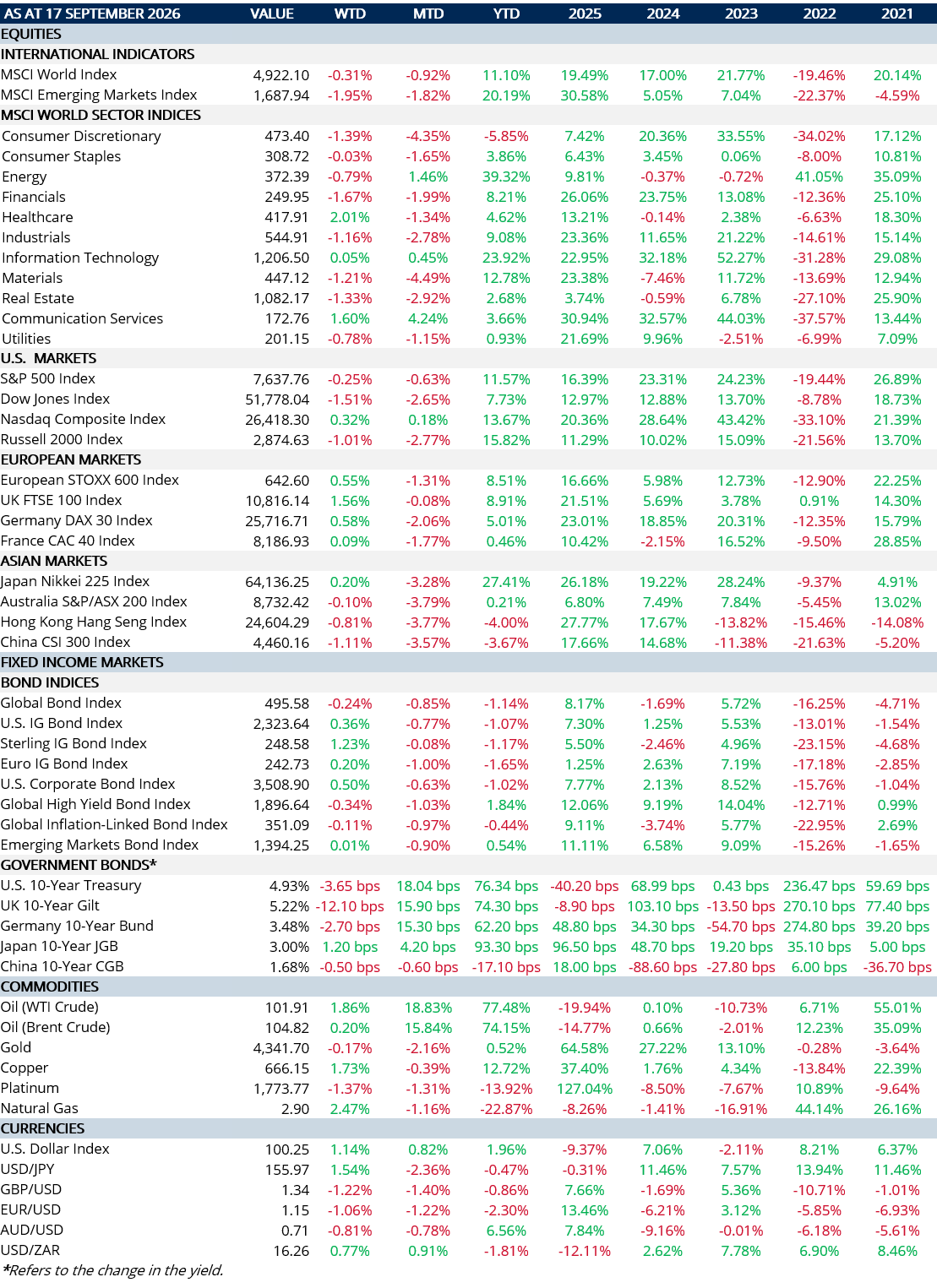
The Fed rate hike on Wednesday saw rates rise +0.25% to 3.75% to 4.00%. It was unanimous: 12 to 0. Markets had attributed a probability of over 90% to this outcome. The political ramifications for Fed Chair, Kevin Warsh (KW), are high. It effectively puts him on a war path with President Trump (after all, the mid-terms are around the corner). He’s supposed to be Trump’s man leading the charge at the Fed. So, did KW buckle or was he justified in raising rates? Markets are “happy”…….but markets lag policy, they always have done. It’s only consumer/investor psychology that puts markets on a pedestal and treats them like the oracle.
KW’s approach to central banking is quite simple:
- He leans more towards being a Traditional Central Banker, even a monetary-policy traditionalist: i.e. Raise Rates à Banks charge more à Borrowing slows à Inflation falls. In other words, use rates to maintain price stability, maintain banking-system liquidity and intervene as lender of last resort. Otherwise, leave it to markets to determine asset prices and the cost of long-term capital.
- He doesn’t buy-in to today’s modern-day CBs: Raise Rates à Tell markets what it will do next year à Publish projections à Buy long-end bonds à Influence lending rates à Shape expectations àMarkets essentially react to communication from the CB! [Markets follow, they don’t decide!]
- Pre-2008, the Fed focused on 3 things: setting rates, managing liquidity in the banking system and acting as lender of last resort. Markets were left to get on with it; Post-2008, they have been meddling in the entire financial system (through QE, FX, stress tests, buying corporate bonds during Covid – even equities in the case of the BoJ! Etc.). He’s not saying don’t fight inflation or don’t support financial stability – he’s just saying “leave it to the markets”.
- KW has always been pro-productivity and pro-capital investment. He is unusually optimistic about AI, tech innovation, business investment, deepening capital markets, US economic dynamism and supply-side growth. His economic model is: investment à productivity à greater productive capacity àfaster non-inflationary growth à higher real incomes! He does not believe in tightening rates just because GDP is strong, Employment is firm, Investment is booming or Equity markets are rising. Instead, he asks what does growth actually reflect – is it excess Aggregate Demand (AD) or excess Aggregate Supply (AS, i.e. Productive Capacity)?
Given the above and Wednesday’s rate hike, is KW’s decision in line with his ideology or did he abandon his AS/AD framework? This is where the lines get murky. Before the rate hike, 23 (out of 87) economists expected rates to be left unchanged. Why?
- The biggest new inflation impulse (oil above $100 pb) is a supply shock. Raising rates does not reopen Hormuz or produce more barrels of oil! So why compound the problem for households via a real-income squeeze and potentially impair the Aggregate Demand picture (higher mortgage costs and household spending)?
- Before the August CPI, disinflation appeared to be working. One member said “give disinflation a chance”; another advocated waiting for more evidence. June/July inflation had looked sufficiently encouraging that a September hold was the overwhelming consensus. Only 10 days ago, 70% of economists thought rates would stay on hold; suddenly, just 3 days ago, that dropped to 26%! The speed of change was extraordinary.
- The strong August Non-Farm Payrolls print is insufficient evidence of labour market strength. Such prints are notoriously volatile over the summer period. Furthermore, we have seen numerous, downward revisions to jobs numbers.
- Monetary policy works with an inevitable time lag. Given where the 10y Treasury is, mortgages rates are very high and financial conditions are tightening. So why load it up with another 0.25%?
- What about the AI investment boom? A difficult one because this also expands future AS/productivity thus complicating the inflation interpretation.
- The August CPI inflation print of +0.40% (core was 0.30%) is hardly a trend! As the old saying goes: “one swallow does not make a summer”.
- Aggregate Demand will likely adjust to the supply shock naturally. If it doesn’t and, instead, stays firm/continues rising, then we would have the clearest, strongest evidence a rate hike is warranted. For me, this is the crux of the debate. KW’s defence is perfectly logical: the energy shock has impaired current AS but AD remains surprisingly resilient. All the Fed can do is restrain AD to stop an AS shock becoming deeply embedded. The key question: has AD been given enough time to adjust?!
Conclusion:
Overall, I do not think a +0.25% rate hike now necessarily violates KW’s philosophy on its own – but neither am I convinced the evidence warranted acting now. To my mind, out of precaution if nothing else, he can and should have waited to see if AD responded naturally to the AS shock. The bond market was already tightening as evident with the move in the 10y Treasury towards 5% – so why reinforce without waiting to gauge the impact on AD? I think, for this reason, he buckled! Should the Fed follow with additional tightening as demonstrated per its infamous “dot-plot” (the forecasted voting expectations in the months ahead) without first establishing persistent excess AD, then the charge KW has reverted to the very conventional CB framework he has spent time criticising becomes considerably harder to dismiss. With price pressures spreading beyond conventional energy and thus making core inflation stickier, a rising bond yield environment is proving to be a fiscal funding nightmare. Recently, Bessent said the US can generate at least 3% annual growth to keep pace with the debt pile – even bring it down. Let’s hope so!
ECONOMIC & MARKET SUMMARY…
- As already noted above, the US Fed raised rates by 0.25%.
- BoE held rates steady at 3.75%. It was a 6 to 3 split vote. Governor Bailey warned rising energy costs could force rate hikes this year as inflation, at 3.1%, remains well above the Bank’s 2% target.
- The ECB – who last week raised rates +0.25% – reiterated its stance that geopolitical conflict is keeping medium-term inflation risks heavily tilted to the upside.
- BoJ, as expected, raised rates by +0.25% to 1.25%, a level not seen since 1995. Following decades of deflation, inflation remains persistently above its 2% target and wages are rising sufficiently to sustain this price pressure. It now has to normalise this extraordinarily loose monetary policy.
- Looking at valuations, we have quite a spread. Tech heavy indices are, not surprisingly, on the high/higher side. These include MSCI US on 20X to 23X 12-mth Forward PE; MSCI Dev. World on 18.5X to 22.5X (US heavy); IT on 26.5X to 28X; the low/lower valuations comprise Financials on 11.5X to 12.5X; MSCI EM on 10.3X to 11.6X. In the middle of these ranges are MSCI Japan (15.4X), MSCI Europe (15X); Energy, Materials, Utilities and Consumer Staples all around 15X to 16X.