Next week (Tuesday 3rd October), attention turns to the US midterm elections. Current forecasts [Source: Reuters/Ipsos, 26 October 2026] have the Democrat lead at a steady 8% to 9%. This is twice the level needed to overcome the hurdle imposed by “Redistricting” (see my commentary of 10th July). (1) Widespread dissatisfaction with the economy, (2) inflation (especially at a household level) and (3) President Trump’s low approval ratings (around 32%) are the main drivers.
Implications for House and Senate seats: On current polling [Sources: Cook Political Report and 2026 Senate Election Ratings], the projections are:
| House of Representatives | Senate | |
|---|---|---|
| Total Seats | 435 | 100 |
| Threshold to reach a majority | 218 | 51 |
| Seats being contested | All 435 | 35 |
| Current Republican position | Narrow majority | 53 seats |
| Projected Outcome (NBC 30th Oct.) | Democrats 227; Republicans 208 (assumes the 11 “toss-up” seats all go to the Republicans) | Democrats 50; Republicans 46; “Toss-up” seats 5; If all 5 go to the Reps, the Vice President (JD Vance) has the casting vote à Republicans keep control. |
| Policy importance | Taxation, spending, legislation, investigations | Legislation, appointments, treaties |
The House of Representatives (“The House”), is pretty much a foregone conclusion – the Dems take it; the Senate is a different story and hangs in the balance…..and the Senate is key when it comes to implications for Policy-making. Let’s split these on two levels, Foreign Policy & Domestic Policy:
Foreign Policy: the following are the active issues:
- Military strikes: Trump can initiate limited operations WITHOUT advance Congressional approval – subject of course to legal constraints. Reality: once you start strikes, it’s very difficult for Congress to back out!
- Sustained Military conflict: Trump can continue operations while simultaneously disputing Congressional restrictions.
- Iran: While Congress can restrict funding and legislate limits, the reality is Trump can retain considerable operational flexibility.
- Sanctions: Trump can tighten or relax many sanctions without new legislation.
- Trade Embargoes: Trump has significant executive discretion.
- Treaties: Trump has leeway via Exec. Orders; Senate needs two-thirds approval of those Senators present.
Domestic Policy: Note the following:
- Monetary policy: Job of the Fed – regardless of all the taunting Warsh receives!
- Tariffs/Trade: Trump can act independently within existing statutory authority; Congress can legislate; Courts can review. The reality is Trump is pretty much done on tariffs!
- Immigration: Trump has substantial executive discretion.
- Taxation: Trump can’t change it unilaterally; could find himself shackled here.
- Appointments: Trump can nominate; Senate generally confirms; Democrats can/will be obstructive.
- Spending: Here, the Democrats can play hardball – but if the economy is slowing, it could backfire big time!
Conclusion/Markets:
- The ideal scenario for Trump is an all-out Republican win in both chambers – but highly unlikely; He will need to pull quite some rabbit between now and next Tuesday.
- Democrats winning both chambers is not impossible. If it happens, it would be very obstructive for Trump who would then be totally reliant on Executive Orders.
- If the result lands inbetween (i.e. Democrats take the House and the Republicans retain the Senate), Trump can still function while facing manageable obstacles.
- As Commander-in-Chief, Trump can’t just go and wage war…..but the Congressional process is convoluted and open to challenges. There are ways and means for him to stall the process.
- On Iran, even if the Democrats win both Chambers, Trump can always frame things as necessary for National Security! BUT if US casualties start rising even further, oil prices increase further still and the electorate turns against the war even more……then, Trump’s leverage starts to disappear fast.
- Does Trump care? Yes, very much – just not in the conventional perspective…..more from his personal, ego perspective! It would be an outright rejection of his Presidency if both chambers fell to the Democrats. He wants his legacy to continue…..for that, he needs to leave things favourable for a Republicans win in 2030 rather than risk seeing it all undone!
- Interestingly, neither party is rated highly in the polls to manage the economy (Democrats 37% vs Republicans 33%). I can understand this from a Republicans perspective as they are the party in power; but it must be deeply concerning for Democrats that they too are not trusted on the economy!
- And markets? Potential outcomes are shown below. The irony of an all-out Democrat win is that it likely causes even more mayhem vs their Republican equivalent….and mayhem for the next two years of Trump’s remaining Presidency will not put the Dems in a good starting point come 2030.
Legend: ✅ Positive/favourable | ➖ Neutral/mixed | ❌ Negative/unfavourable
| Market variable | Republican Congress (House + Senate) | Democratic House / Republican Senate | Democratic Congress (House + Senate) |
|---|---|---|---|
| GDP | ✅ Fiscal stimulus, deregulation and investment incentives support growth; The potential offset are higher rates and inflation | ➖ Despite reduced fiscal stimulus, sustained policy continuity and private investment should sustain growth | ➖ Legislative gridlock limits fiscal expansion à potential drag on growth; this is only partly offset by the resulting lower inflation/yields from lower GDP |
| Fiscal policy | ➖ Greater scope for fiscal expansion; but deficit concerns mount | ✅ Gridlock limits new deficit-financed spending | ➖ Fiscal restraint offset by budget confrontation |
| Treasury yields | ❌ Higher yields possible from fiscal expansion and inflation | ✅ Reduced fiscal stimulus could ease upward yield pressure | ➖ Lower fiscal expectations, but shutdown/debt-ceiling risks |
| USD | ➖ Growth/rate support offset by fiscal concerns | ➖ Fed policy remains dominant | ➖ Fiscal restraint offset by political uncertainty |
| Equities | ✅ Policy continuity; supportive for business investment | ✅ Gridlock limits legislative uncertainty; executive policies continue | ➖ Greater oversight and regulatory uncertainty |
| Oil / geopolitical risk | ❌ Trump retains maximum political flexibility | ➖ Military powers remain; congressional scrutiny increases | ➖ Greater pressure for de-escalation, but presidential authority remains |
| Inflation | ❌ Fiscal expansion and tariffs could sustain inflation | ➖ Limited new stimulus; tariffs and oil remain risks | ➖ Fiscal restraint potentially disinflationary; oil remains dominant |
| Fed / monetary policy | ➖ Inflation pressures could keep rates higher | ➖ Limited direct impact on Fed policy | ➖ Greater scrutiny; monetary independence unchanged |
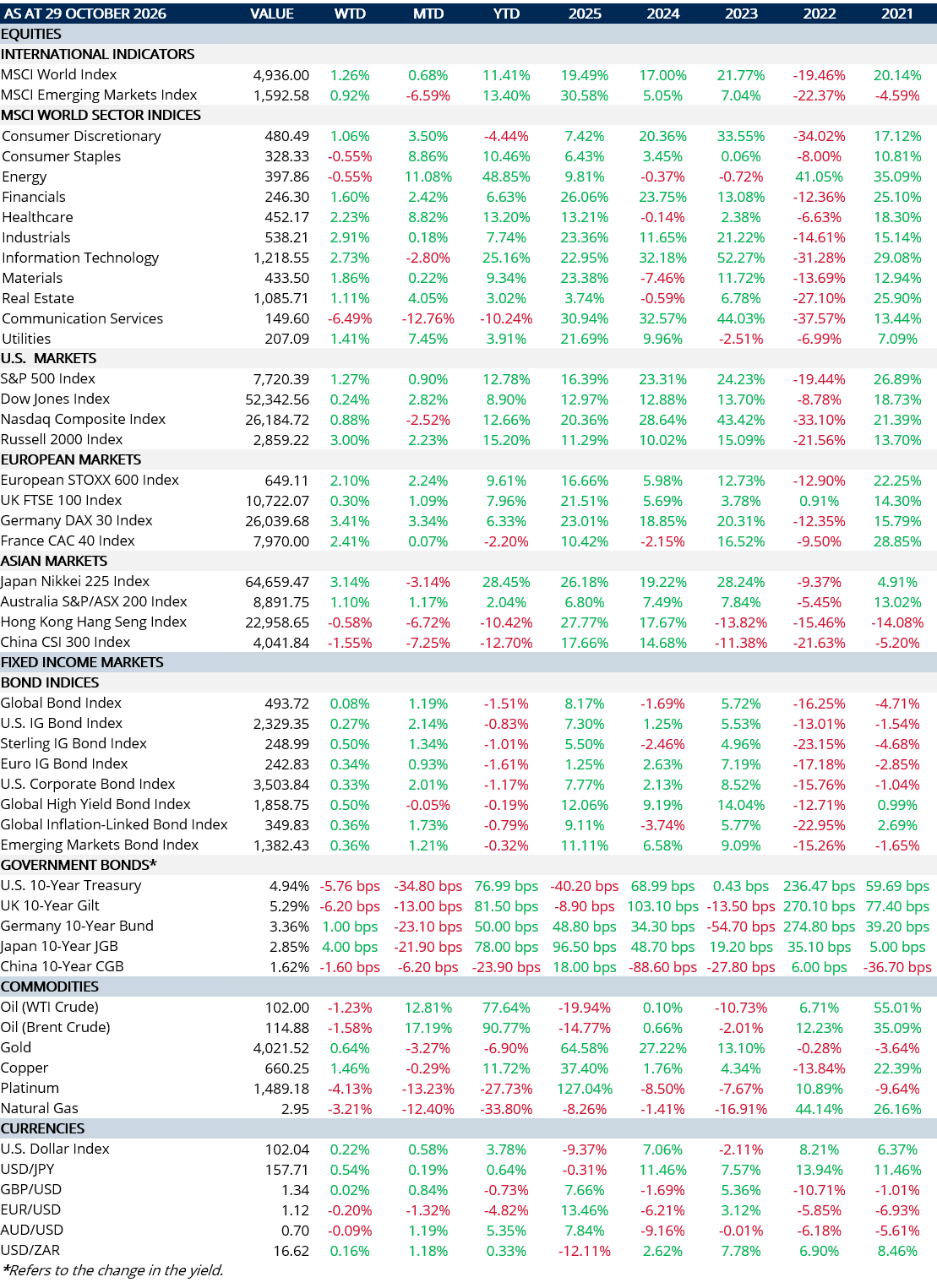
ECONOMIC & MARKET SUMMARY…
- Global growth has remained surprisingly resilient. US Q3 real GDP grew 3.4% y/y (consumer spending rose a very buoyant 3.8% y/y, business fixed investment 12.7% y/y largely due to the AI rollout, housing investment fell -3.4% y/y). Chinese Q3 GDP came in slightly higher than expected – but is being driven by a rising trade surplus. Domestic demand remains weak. Eurozone Q3 GDP slowed to 0.4% y/y (from o.6% in Q2). France was the main driver with a -0.1% contraction.
- Oil prices remain firmly skewed to the upside as Iran’s scores successes in both Straits.
- Yield Curves, in DMs (Dev. Markets) have risen some 100 bps, on average, since early 2026. GS estimates this subtracts some -0.60% in GDP (via housing, consumer durables and business investment assuming these yields remain sustained).
- AI spending might be peaking but adoption is picking up à impacting labour markets.
- We’re not quite there in terms of a pause in rate hikes. The Fed and ECB both paused but a hike, before year-end, is on the cards given the way inflation is heading. ECB head, Christine Lagarde is stepping down 7th February – presumably to succeed Macron in next year’s French Presidential elections! The RBNZ kept rates on hold while the BoC (Canada) hiked +0.25%.
- Meanwhile, inflation keeps creeping up and, with bond yields even at current levels, financial conditions remain tight. If there is no resolution in the Middle East, it will become even tighter.
- In Brazil, markets were roiled by the re-election of Lula in the second round of voting. Brazilian markets lost over 20%!