Andy Burnham economic policy is now firmly in focus as markets, voters and investors try to understand what his leadership could mean for UK public spending, housing, transport, welfare and regional investment.
Macbeth shall never vanquish’d be until Great Birnam Wood to high Dunsinane Hill shall come against him!
In Shakespeare’s Macbeth, the witches told Macbeth he could not be defeated until a forest literally uprooted itself and walked up a hill. Macbeth laughed at the idea as he knew trees cannot walk and believed he was permanently invincible. The reality was very different: his enemies used clever camouflage. Soldiers cut down branches from Birnam (get it?!) Wood as they marched.
In all walks of life, people often dismiss a major risk or trend because they think “that could never happen!” By the time they realise it’s actually happening (just not in a way they expected), it’s too late. What we have witnessed is a very British coup: Starmer’s exit was swift and bloodless. Everything was neatly and quickly handled behind closed doors. I covered Andy Burnham’s past life as Mayor of Greater Manchester a few weeks back, comparing him to Margaret Thatcher. It’s still very early days but, since his formal appointment as PM, we can deduce a bit more about his vision and goals based on his No. 10 Downing Street speech (on Monday). His Cabinet line-up defines how he plans on accomplishing that vision and meeting those goals.
Let’s start with what he appears to believe:
- Politically: Britain has been over-centralised and poorly governed from Westminster. He places far greater faith in mayors, councils, local institutions, cross-party collaboration and real/measurable practical delivery.
- Economically: He believes the post 1980 economic model (essentially the Thatcher era) has resulted in regional decline, weak industrial capacity, expensive essential services and excessive privatisation of public necessities.
- Socially: He is a big believer in communitarianism – a philosophy aimed at bringing the individual and the community together rather than just promoting the individual. His choice of language typifies this – care, common purpose, unity, etc.
There is a logic underlying his programme i.e. better housing + better transport + mental-health support + skills + regional investment à (1) higher employment & productivity; (2) lower welfare dependence & reduced pressure on the NHS and (3) stronger regional economies and public finances. Unlike most governments we have seen to date, it certainly beats a disconnected set of spending promises amounting to tinkering with the budget around the edges for cosmetic purposes just to win enough votes to be re-elected. How does he deliver? That’s where the newly-formed cabinet changes come into play – to “make it happen”:
- OUT goes Rachel Reeves: she was the former Chancellor. In my opinion, she is the primary reason for Starmer’s downfall re the economy (the other being the Mandelson saga). Her departure marks the end of a “Treasury-dominated” Starmerism era – a style that does not work for Burnham.
- IN comes John Healey: he is the new Chancellor – and a surprise announcement. Healey quit as defence Secretary under Starmer because he felt defence had been dangerously neglected. Now, he has to balance higher defence spending with fiscal orthodoxy. He does have previous experience of working in the Treasury. Fiscal caution remains but within Burnham’s political framework. He’s also unlikely to create a rival power base.
- IN comes Miatta Fahnbulleh: the new Energy Secretary. Her job is essentially to ensure affordability and public intervention are serious.
- IN comes Angela Rayner: who returns to her former role as Housing Secretary. She previously quit following a tax scandal. Her re-appointment ensures council housing and devolution remain central.
- IN stays Yvette Cooper: but is moved to Health Secretary. She is tasked with ensuring social-care reform remains substantive.
- IN stays Shabana Mahmood: who remains Home Secretary. This keeps migration and public order firm within Burnham’s political framework.
- IN comes Wes Streeting: as Defence Secretary (he was previously Health Secretary but resigned under Starmer). This way, Burnham contains a rival.
- IN stays Ed Miliband: but is moved from Energy Secretary to Foreign Secretary. It’s a consolation prize for not giving him Chancellorship while keeping him away from the domestic, economic agenda.
The real issue at stake for markets – which Burnham has openly stated as useful but inappropriate as the sole mechanism for essential services – is how much will all this cost? We have the first signs of what that picture will look like until the Autumn budget. At the moment, we can only infer based on (1) his speech delivered on Monday (following his formal appointment), (2) his track record as Mayor of Greater Manchester and (3) what has been said/implied by him and others. He has stated “later this year, I will bring forward….a 10-year plan, laying out a path from where we are now to where I believe we all want Britain to be”.
Based on all of this, I have tried to cost up the first half of Burnham’s equation (i.e. “better housing + better transport + mental-health support + skills + regional investment“). It generates some eye-watering figures!
| Programme | Existing commitments under Starmer | A serious programme under Burnham | Added cost over 10 yrs | Basis of estimate |
|---|---|---|---|---|
| Council & social housing | Existing 10-year Affordable Homes Programme, £39bn, funds ~300,000 homes. Assumes Burnham substantially expands it. | 500,000–750,000 additional social/council homes; land remediation; infrastructure; council borrowing support. | £60–100bn | ~£130k grant per home implied; additional homes × comparable subsidy, adjusted for infrastructure and land. |
| Regional & local transport | City-region transport settlements, incl. the £15.6bn programme, already cover part of the requirement. | Bus franchising; lower fares; integrated ticketing; local rail; trams; stations; roads. | £35–60bn | Extending Greater Manchester-style transport nationally, plus operating subsidies and capital. |
| Mental health | NHS spends ~£16bn p.a. on mental health. Estimate reflects expansion above current plans. | Community teams; youth support; school provision; crisis services; workforce expansion. | £25–45bn | ~15–25% expansion in workforce and services over the decade, phased. Mostly current expenditure. |
| Skills & youth employment | Apprenticeship levy, Skills Bootcamps and FE funding remain in place. | FE colleges; apprenticeships; technical education; retraining; youth guarantee; employer incentives. | £20–35bn | Additional £2–3.5bn p.a. above current skills budgets for a significantly expanded programme. |
| Regional investment | Levelling Up, Shared Prosperity and regional capital programmes provide an initial base. | Industrial sites; brownfield remediation; digital infrastructure; business support; devolved funds. | £35–60bn | Benchmarked against historical regional development, adjusted for a larger devolution-led strategy. |
| Gross total before overlap | Existing commitments already account for ~£75–100bn of this policy area over the decade. | 10-yr GDP uplift +1% to +2.5%. Impact on 10-yr gilt yields +0.20% to +0.50%, largely front-loaded if debt-financed. | £175–300bn | Sum of incremental programme costs before allowing for interactions between programmes. |
The TOTAL, EXTRA cost (over 10 years) would amount to £175bn to £300bn. That’s an equivalent of an extra £17.5bn to £30bn pa requiring funding if the above proves to be a fair projection. For political reasons, it’s highly unlikely to hit us from year 1…..otherwise, Labour will sure as hell lose the next election! More likely, it will start on the lower side (say £8bn to £15bn for the first two years), then ramp up to £18bn to £25bn (in years 3 to 5) and then £25bn to £35bn pa in years 6 to 10. I also suspect after his first two years, the Labour Party will assess how things are looking in the polls for a possible snap election. This would give them the leverage to go full steam ahead with the rest of the eye-watering funding raises!
What are the possible funding sources? Basically, a mix of options such as:
- Taxation (income tax, NIC, corporation tax, VAT)
- Spending reallocations (across different departments)
- Borrowing for investment (national Treasury DMO)
- Public-corporation borrowing (e.g. state-owned bodies such as GBE borrowing independently of Treasury)
- Council and Housing-association debt (e.g. local authorities / housing associations borrowing to build)
- Pension-fund and Private capital
- Land-value capture (e.g. where public investment results in land value appreciation, part of the uplift is taken in the form of levies or taxes to unlock some/all of that appreciation)
- Regulated utility investment (e.g. water or electricity borrow or issue equity)
- Welfare savings (i.e. by doing all and more of the above, the government ends up spending less on welfare, crime, homelessness, etc.)!
What Burnham does will be a function of his politics (i.e. how far to the left) as well as the company he keeps (e.g. a key economic and policy advisor to Burnham is Lord Jim O’Neill – himself a celebrated economist and former senior Goldman Sachs Partner – who is providing guidance on regional devolution, tax reform, infrastructure spending). The above is a moving picture and may prove overdone or even underdone. Our first proper clues will be in the lead up to the Autumn budget. However, one thing is certain – he does not have the luxury of time. He effectively only has two years in which to prove his ability to turn things around. It will take a lot more than removing VAT from household electricity bills (estimated cost of £850m) or committing £340m to rough sleeping or capping bus fares to £2 (total cost £300m). Note also, scrapping digital ID is all well and good but that was never funded or in the first place. So, if he wants to re-allocate that, he will have to find a fresh £1.8bn!
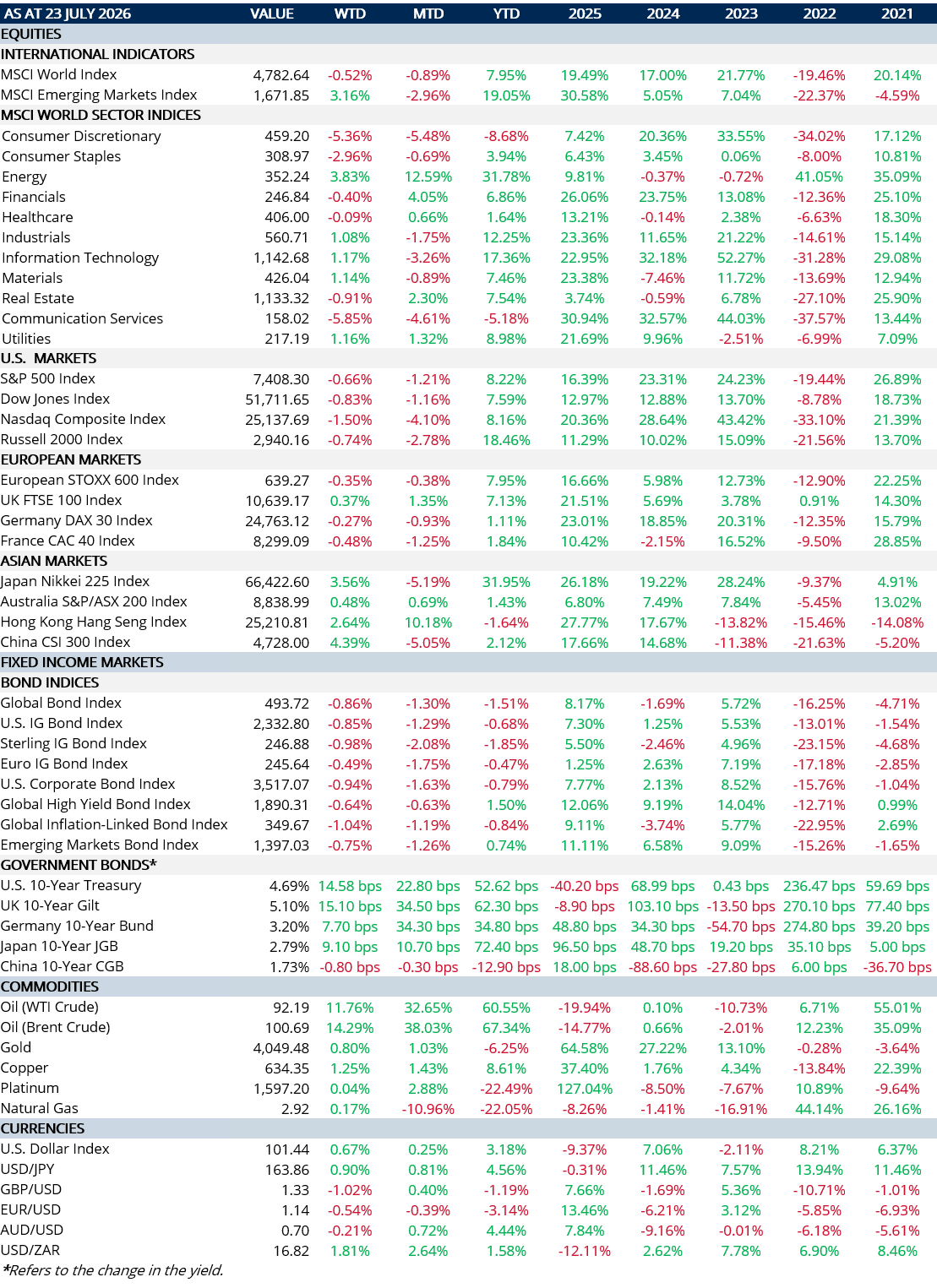
MARKET SUMMARY…
- The Middle East has really flared up as the US continues its attacks on Iran for the 13th consecutive night. This is now the decisive moment since it all started some 5 months ago.
- Global bond yields have faced huge, upward pressure as energy prices soar. Oil (WTI and Brent) have risen between 12% and 14% with Brent breaking through $100 pb. It’s Risk-Off.
- The US Fed may delay rate action until September (thus boosting Treasuries today); the ECB remains hawkish and looks likely to raise rates in September on the back of higher energy costs!
- Rising energy costs look like pushing UK inflation to 5%; Japan is getting closer to accelerating interest rate normalisation to stabilise the Yen.
- To compound matters, tariff wars are back with the US imposing hefty increases of 10% to 12.5% duties on imports from most major trading partners. This is to rebuild what was overturned by the US Supreme Court. Canada has been hit with a new round of 50% tariffs effective 19th August on a wide range of items including wine, whisky, cement and even hockey sticks.