ISRAEL: A change of Government…….or a change of direction?
Next week (Tuesday 27th), Israel holds its national election. It is shaping up to be far more than a referendum on current PM, Benjamin Netanyahu. With the Iran conflict, Gaza, regional normalisation and relations with Washington all in play, the consequences extend well beyond Israel’s borders. The central questions are (1) NOT who wins…..rather who can GOVERN and (2) whether a different government would produce a materially different Israel.
Let’s start with latest polling which, even in the last few days, show significant changes. The table below shows projections as of the 20th to 22nd of October. The Knesset (Israel’s Parliament), comprises 120 seats; 61 are required for an outright majority:
| Pollster / broadcaster | Poll published | Netanyahu bloc | Main opposition | Arab parties | Other parties | What it suggests |
|---|---|---|---|---|---|---|
| Kantar / Israel Hayom | 22 Oct | 50 | 52 | 14 | 4 | Neither bloc wins |
| Yossi Tatika / Zman Yisrael | 22 Oct | 51 | 51 | 14 | 4 | Deadlock |
| Midgam / Channel 12 | 21 Oct | 47 | 55 | 14 | 4 | Opposition ahead |
| Midgam Project / Channel 13 | 21 Oct | 49 | 52 | 15 | 4 | Neither bloc wins |
| Direct Polls / i24NEWS | 20 Oct | 58 | 48 | 14 | – | Netanyahu close |
| Filber / Channel 14 | 20 Oct | 62 | 44 | 14 | – | Netanyahu majority |
| Overall conclusion | 47 – 62 | 44 – 55 | 14 – 15 | 0 – 4 | Substantial polling disagreement |
[Sources: Israel Hayom / Kantar; Zman Yisrael / Times of Israel; Channel 12 / Midgam; i24NEWS / Direct Polls; Channel 14 results. Channel 13 party projections are reported in the independent election polling database].
The differences are quite substantial! Channel 14 is the only one projecting a Netanyahu majority! The others have his bloc well short. These are not trivial, polling discrepancies; they produce entirely different political outcomes.
Take a look at the next table below which shows a breakdown of the above blocs. Apologies for its length but it’s important to highlight who the players are, their allegiances and – critically – their politics; the latter will be decisive in determining the road ahead and what issues voters might gravitate towards; in particular, how much – if anything – they might concede. An Israeli government does not legally require 61 affirmative votes to take office. It just needs more in favour than against when the Knesset holds a confidence vote. A 61-seat coalition is preferable for stability but a minority government can be installed if enough, other members abstain:
| Political Bloc | Party / Leader | Projected Seats | Iran / National Security | Gaza / Palestinians / West Bank | Domestic / Economic Policies |
|---|---|---|---|---|---|
| NETANYAHU BLOC | Likud (Benjamin Netanyahu) | 21 | Prevent Iranian nuclear capability; military deterrence; supports aggressive action against Iran and its proxies. | Opposes Palestinian statehood; favours continued Israeli security control over Gaza; supports settlement expansion. | Pro-market economic policies; judicial reform; security expenditure prioritised. |
| Otzma Yehudit (Itamar Ben-Gvir) | 8 | Strongly hawkish; favours military escalation against Iran and militant groups. | Advocates Israeli sovereignty over the West Bank; supports renewed Jewish settlement in Gaza; opposes Palestinian statehood. | Nationalist social policies; tougher policing; expanded security powers. | |
| Shas (Aryeh Deri) | 8 | Generally supports strong Israeli defence; less ideologically focused on Iran than Likud. | Pragmatic on territorial issues; prioritises religious and community interests over territorial expansion. | Protects ultra-Orthodox education funding, welfare benefits and military-service exemptions. | |
| United Torah Judaism | 7 | Supports national security consensus; generally defers to coalition leadership on military strategy. | No consistent expansionist agenda; principally concerned with religious autonomy. | Protects ultra-Orthodox institutions, religious education, subsidies and conscription arrangements. | |
| Religious Zionism–Zehut (Bezalel Smotrich) | 6 | Strongly hawkish; supports military confrontation with Iran and its regional allies. | Supports West Bank annexation, settlement expansion and permanent Israeli control; opposes Palestinian statehood. | Religious-nationalist agenda; judicial restructuring; economically conservative orientation. | |
| NETANYAHU SUBTOTAL | 50 | Broadly hawkish on Iran. | Strong opposition to Palestinian statehood. | Internal tensions over conscription and religious funding. | |
| OPPOSITION BLOC | Yashar (Gadi Eisenkot) | 23 | Strong deterrence against Iran; supports military action where necessary, alongside strategic coordination with the US. | Favours a security-led approach with greater diplomatic flexibility; opposes unilateral annexation; cautious on Palestinian statehood. | Universal military service; institutional reform; independent inquiry into October 7; economic competence. |
| Together (Naftali Bennett/Yair Lapid) | 14 | Strongly hawkish on Iran; supports military superiority and close US cooperation. | Bennett opposes Palestinian statehood; Lapid supports a conditional two-state solution. Both prioritise Israeli security. | Economic liberalisation; reduced bureaucracy; institutional safeguards; greater burden-sharing. | |
| The Democrats (Yair Golan) | 8 | Supports military deterrence against Iran but places greater emphasis on diplomacy and regional cooperation. | Supports a negotiated Palestinian settlement; opposes annexation and settlement expansion; advocates humanitarian protections. | Social-democratic policies; civil rights; judicial independence; stronger public services. | |
| Yisrael Beiteinu (Avigdor Lieberman) | 7 | Strongly hawkish on Iran; favours decisive military action and robust deterrence. | Supports territorial separation on security grounds; opposes concessions without credible security guarantees. | Secular nationalism; universal conscription; reduced ultra-Orthodox privileges; pro-business reforms. | |
| OPPOSITION SUBTOTAL | 52 | Broad security consensus; potentially greater diplomatic flexibility. | Significant differences over Palestinian statehood. | Broad agreement on institutional reform and conscription. | |
| ARAB PARTIES | Joint List (Yousef Jabareen) | 9 | Opposes military escalation; favours diplomacy and regional de-escalation. | Supports Palestinian self-determination, ending occupation and a two-state settlement; opposes annexation. | Equality for Arab citizens; increased public investment; anti-discrimination policies. |
| Ra’am (Mansour Abbas) | 5 | Favours regional stability and diplomatic solutions; avoids strongly interventionist security positions. | Supports Palestinian rights and opposes annexation; pragmatic about parliamentary cooperation. | Increased investment in Arab communities, infrastructure, housing and public services. | |
| ARAB SUBTOTAL | 14 | Prefer diplomacy and de-escalation. | Support Palestinian political rights and oppose annexation. | Prioritise equality and community investment. | |
| UNALIGNED | Reservists–Economic Party (Yoaz Hendel/Yaron Zelekha) | 4 | Strong national security; emphasis on military preparedness and universal service. | Security-first approach; no clearly established comprehensive Palestinian settlement policy. | Universal conscription; economic reform; competition and cost-of-living measures; governance reform. |
| TOTAL KNESSET | 120 | 61 seats required for an outright majority. |
The political obstacles are quite formidable:
- Eisenkot has outright rejected serving under Netanyahu.
- Bennett/Lapid and the Democrats are committed to replacing Netanyahu.
- Lieberman rejects governing with the ultra-orthodox parties.
- Hendel has ruled out joining a coalition with either ultra-orthodox or Arab-majority parties!
- Ra’am remains open to political engagement; Jabareen has indicated willingness to support certain anti-Netanyahu initiatives from outside government.
- Benny Gantz (Blue and White) has withdrawn from the election. This removes another potential source of wasted votes – though their redistribution is unclear.
- Also running is Ofer Winter, a former Israeli military commander (Brigadier-General). His Amcha Yisrael party is a new right-wing, religious-nationalist political party and is strongly hawkish on security. He favours a forceful military approach on Iran and Gaza! He is broadly aligned with Netanyahu’s right-wing bloc. He’s projected to win 4 seats – though the latest Kantar survey had him falling below the 3.25% electoral threshold to qualify for seats. This is significant: either he comes up trumps with the additional seats for Netanyahu and shapes ideology going forward or he receives no seats and potentially wastes votes that could have benefitted Netanyahu!
Conclusion:
- A minority government seems to be where Israel is headed; it could be politically preferable to the opposition leaders vs leaving Netanyahu in office indefinitely!
- Little separates the two main blocs over Iran. It’s more about degrees of “hawkishness”. Removing Netanyahu will not necessarily mean a less confrontational policy. In fact, some of his principal opponents have adopted positions that are just as hawkish.
- Palestine/West Bank reveals much greater differences: The more meaningful changes could arise in the composition of the coalition and its dependence on religious and nationalist parties – especially over their willingness to negotiate over Gaza and the West Bank as well as engage with Arab governments. The latter will be telling and one that will be watched closely by surrounding Arab States. If there is meaningful improvement in relations with neighbouring Arab states that results in a more coordinated regional diplomatic and security environment, it could prove quite unnerving for Iran!
- The Arab parties are potentially decisive – but politically divisive! The arithmetic is quite straightforward; if the Arab parties pull of their expected 13 to 14 seats, IN THEORY they could align themselves with the Opposition bloc to give a 66-seat coalition. However, some members of the opposition bloc have made it clear they will NOT align themselves with the Arab parties. If anything, the Arab parties are more likely to succeed under a “Supply and Confidence” motion. That way, they will always be Kingmakers while the opposition bloc does not have to be “seen” aligning with them.
- Domestic governance is arguably the biggest dividing line: Military conscription, judicial independence and the influence of the ultra-Orthodox parties distinguish the two blocs more clearly than fundamental security objectives. The fact that Haredi Jews are exempt from military conscription is a very touchy subject! The Haredis – ultra-orthodox Jewish men studying full-time in religious seminaries (called Yeshivas) – have historically received a blanket exemption from military service. However, Israel’s Supreme Court ruled (in 2024) these exemptions are unlawful.
- Overall, while a new government may be less ideologically confrontational and possess more diplomatic flexibility, it may not necessarily be less willing to use military force. Therefore, from the perspective of an Israeli Jewish voter, they needn’t worry about a fading tough stance towards Iran and national security. On this, both blocs are pretty much aligned in principle despite differences in methodology. Ultimately, it comes down to “domestic governance” and how to approach “Palestine/West Bank” – probably in that order! I think these set the scene for next Tuesday’s election!
How will markets react?? Very much around the electoral outcome (see scenarios and probabilities below). Key question will be whether it reduces the probability of renewed regional escalation – or indeed improves the prospects for sustained energy flows through the Gulf thus creating conditions for greater regional economic cooperation. Right now, the election is so close to call that a deadlock seems the most likely outcome; the second most likely scenario (ironically) is a return of a Netanyahu bloc. Let’s see what tricks the master politician has up his sleeve between now and next Tuesday. “Elevated uncertainty” seems to dominate the outcomes with a combined 75% probability. Not great at all! Perhaps the impetus for progress might come from outside e.g. a way forward in reaching a deal between the US and Iran…..it’s hard to see how it will be from within Israel!
| Election outcome | Iran confrontation | Arab normalisation | Regional risk assessment | Previous probability (1w ago) | Current probability |
|---|---|---|---|---|---|
| Netanyahu + nationalist-right coalition | Continued hard line; possible further escalation | Difficult if West Bank policy hardens | Elevated | 25% | 20% |
| Eisenkot / centrist-led majority government | Strong deterrence; potentially more diplomatic flexibility | Greater scope for engagement | Moderately improved | 15% | 10% |
| Broad national unity government | Security continuity; potentially stronger domestic mandate | Depends on agreed policy programme | Moderate | 10% | 10% |
| Minority government | Security policy broadly maintained; domestic constraints | Some diplomatic flexibility, but politically fragile | Elevated uncertainty | 5% | 15% |
| No viable government / prolonged deadlock | Netanyahu continues as caretaker until replaced | Diplomatic initiatives potentially delayed | Elevated uncertainty | 45% | 45% |
| TOTAL | 100% | 100% |
ECONOMIC & MARKET SUMMARY…
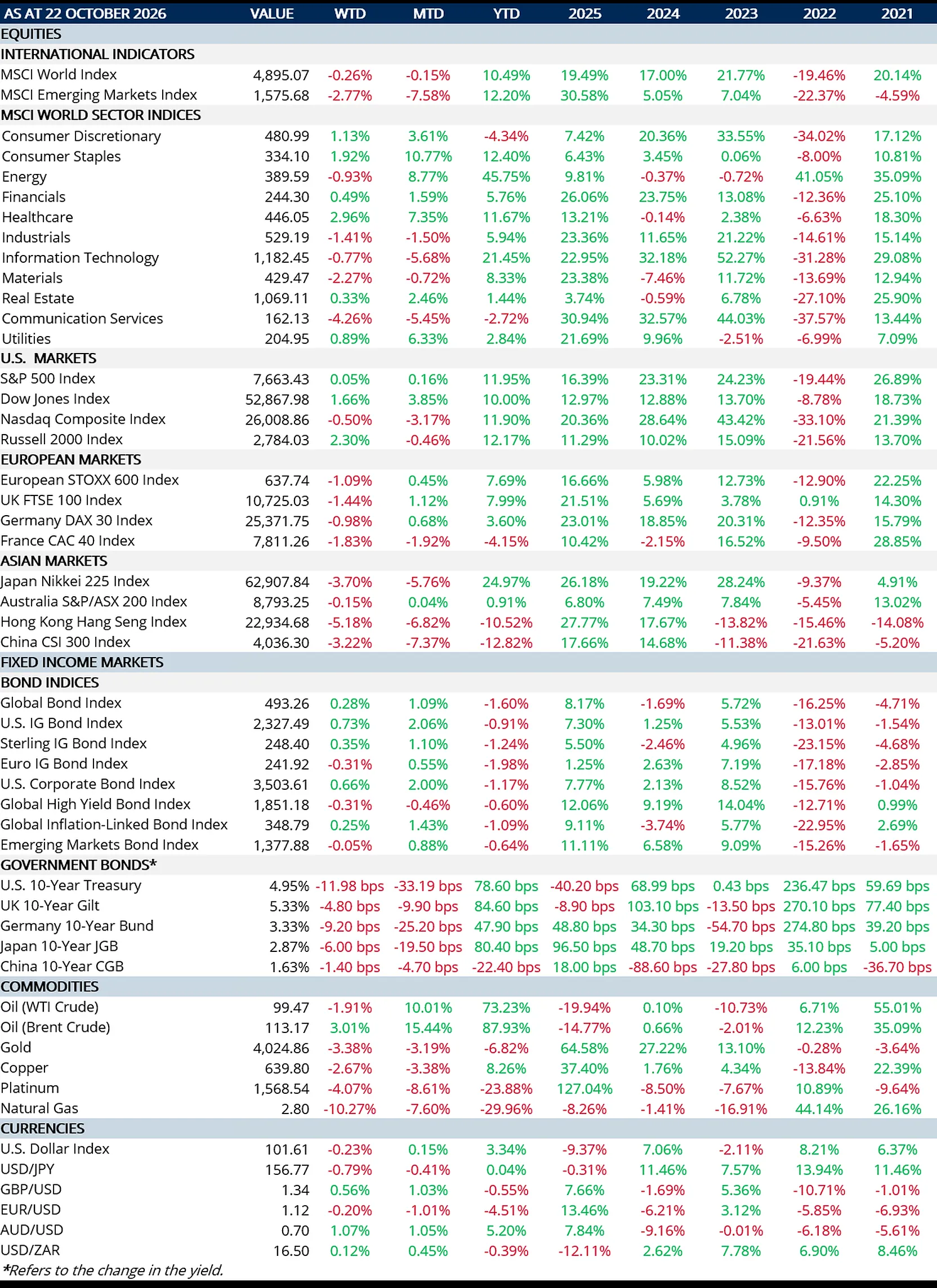
- In a word, rough! Continuing worries over AI (despite good earnings releases the past few days), perceived lack of progress between the US and Iran, next week’s Israeli election (see above analysis), rising inflation releases, impact of AI on jobs, student riots across France and copycat riots in Spain, Italy & Lisbon) and Bond Yields soaring (France’s 10y now sitting over 5%, some 175bps over the German 10y indicating higher, perceived risk).
- Markets have largely discounted the possibility of the Fed raising rates next week. On the back of this, yields have fallen a little.
- Eurozone policymakers will be reviewing/assessing systemic threats to the financial system and do have the tools to deal with it. We have seen this (e.g. T/LTRO) from previous years.