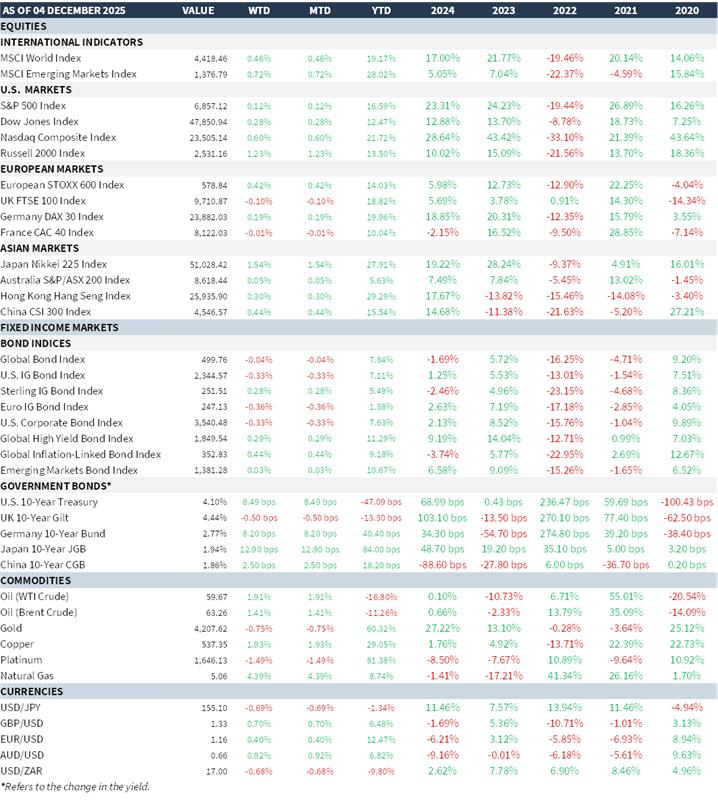
Markets have been quiet and cautiously calm over the last week or so. Last week was Thanksgiving (Thursday & Friday) and, if the mood in the UK is anything to go by, the Festive wind-down is underway and gathering pace. Next week (9th/10th) is when have the last FOMC (Fed Open Market Committee) meeting of the year where the Fed can vote on rate action. The latest market implied probability (CME Group) of a rate cut stands at 87.2% for a -0.25% cut.
Between now and next week, we have some key data releases. Some of these have the potential to rock markets such that should the Fed decide against an expected rate cut – or even introduce wording suggesting they are very nervous about more rate cuts down the line – then a combination of tight financial conditions and thin liquidity could hurt markets going into the year-end. Some of these data releases include:
- Europe/UK: Construction PMI, Retail Sales, Vehicle Registrations, Home Prices, Employment, Inflation.
- US: Challenger job cuts, Continuing Jobless Claims, Durables, Inflation, Employment.
- Japan: Household Spending, Wages, Inflation.
- China: Trade, Inflation.
- Commodities: Natural Gas and Oil Reserves, Speculative Net Positions.
Labour markets, wages and inflation will be the most closely watched! Comments on the week thus far:
- Speculation is rising Kevin Hassett will soon be nominated as the next Fed Chair to replace Powell. No surprise that he is a dove! This has prompted a rise in long-dated yields while anchoring short-dated yields (i.e. yield curve steepening) on expectations his stance will drive inflation higher.
- European yield curves have also steepened. Activity data (as reflected in the PMI surveys) was slightly better than expected. However, there is a divergence here – southern Europe is stronger vs northern Europe and should impact asset allocation within the European portion. Pressures on German Chancellor Merz are rising. Just like France, the emphasis in Germany seems to be doing everything possible to keep the “far-right” from gaining control. In the process, the country loses out! By contrast, Italy goes from strength-to-strength in terms of market confidence: the 10y Italian BTP is just 0.70% above the German 10y Bund – its lowest since 2009. [The spread denotes the perceived risk with the German Bund traditionally the safe-haven asset and benchmark in Europe. Italy, once the basket case of Europe, is now hovering only a little above the German Bund].
- In the UK, despite gilt-markets remaining steady post the budget last week, further rate cuts are now likely given the prospect of weak growth ahead. The combination of the two will very likely take its toll on the GB£.
- In Japan, the 10-year Bond (JGB) has hit 1.948%. It was last at this level early 1999! Domestic investors are viewing fair value between 2% and 2.25%. BoJ Governor Ueda pre-announced a December rate hike speech (on Monday this week) saying the BoJ would consider the “pros and cons” of such a move this month. These comments resulted in markets pricing in an 80% chance of a rate hike. Even more interesting, PM Takaichi’s administration (which has advocated looser monetary policy) gave little pushback. Quite the opposite – Finance Minister Katayama said she saw no problem with this! Should the next hike proceed, it would take policy rate to 0.75% – something last seen three decades ago. Swap rates now show markets seeing the BoJ eventually raising rates to about 1.5% by mid-2027.
- US weekly jobless numbers improved again, falling -27,000 for w/e 29th November to 191,000. This is a 3-year low.
- US planned job cuts by employers (a survey published by global outplacement firm Challenger, Christmas and Gray) fell a mighty -53% to 71,321 last month. Though still up +24% y/y, it suggests the excess hiring that took place in 2021/22 followed by the subsequent retrenchments is beginning to bottom out.
- European retail sales did not grow – they were flat on the month and remain at 1.5% y/y.
Outlook consideration for 2026?: As year-end approaches, it’s customary to see the outpouring of forecasts and predictions for the next year. The following are going to be the deciding factors for 2026 and, in the remaining two weeklies left for this year, I will attempt to elaborate on a couple of them:
- Central Bank intervention: to what extent will government try to influence/dictate policy action i.e. fiscal dominance? This impacts the yield curve and could be highly counterproductive. It is particularly relevant in the US and Japan. In the US, Trump is trying to exert influence over the Fed in the hope that he can target lower mortgage rates – thereby easing inflationary pressures on US households. There’s a problem with this: the mortgage market in the US is built heavily around the 15-year and 30-year Treasuries. Unless his administration can demonstrate control over inflation, long-end yields will rise. It could end up being a double whammy for him. In Japan, we have just witnessed the first open “spat” between PM Takaichi’s administration and the BoJ led by Governor Ueda. Rising rates will spur the Yen – but a still significant portion of GDP is export-dependent. A strong and rising Yen kills that. It’s a delicate balance – but not an impossible one to achieve.
- Inflation & rates: I can’t emphasise the importance of this! The sheer scale and ever-rising debt picture has made bond markets increasing sensitive to yields. Globally, the challenge has become keeping the consumer well-buoyed (fiscal policy) vs keeping input and output costs contained (low energy costs and increasing productivity via AI). The R* (the neutral rate) will remain at current levels (at best) vs the “la-la land” version of 2%.
- Fiscal policy: These are far-ranging: in the US we have the recently announced rate cuts & tax cuts (OBBB) together with deregulation measures – all designed to boost economic growth; China has implemented a fiscal policy aimed at supporting its economy (a major large-scale equipment trade-in programme launched in March 2024 and expanded in 2025 introducing subsidies new for old equipment together with further household-focused subsidies; additionally a massive Rmb10tn debt management rollout in late 2024 to help local governments restructure their debts); Germany is trying to implement a multi-year €500bn package focused on climate funding, transport, hospitals, energy, science, R&D and digitalisation; The EU is moving towards large funds for specific sectors (e.g. €100bn clean energy fund, Horizon Europe for key research and innovation has raised around €100bn); Japan recently approved a $135bn economic stimulus package.
- AI take-up and productivity impact: This is the hot topic for next year. AI-related capex acceleration is expected to continue thereby boosting activity into 1H 2026. The key question is where, specifically, is that capex going to end up, how will it be funded, what will the uptake look like and how significant an impact will it have on output/productivity. The latter speaks directly to growth with controlled inflation.
- Debasement trade: reality or hype? The US$ is holding its ground. It is still down on the year by about -9% YTD. We know it declines during a “risk-on” environment……but besides the tariff saga back in the early part of the year, it has held up since, even gained a percent or two. The US$ is a consumption-led growth story. If the growth is there (and further AI-related spending will definitely be a boost to GDP), that’s US$-supportive. What the newly constituted Fed (to be) does will simply either accelerate (cutting rates too far, too fast) or moderate US$ moves (temper rate cuts). Overall, I think the debasement trade has been exaggerated – the US exceptionalism story is hardly declining but the Rest of the World is certainly catching up.
MARKET SUMMARY...